
By Shane Rodgers
The transition between education and work for young people is showing early signs of breaking – again.
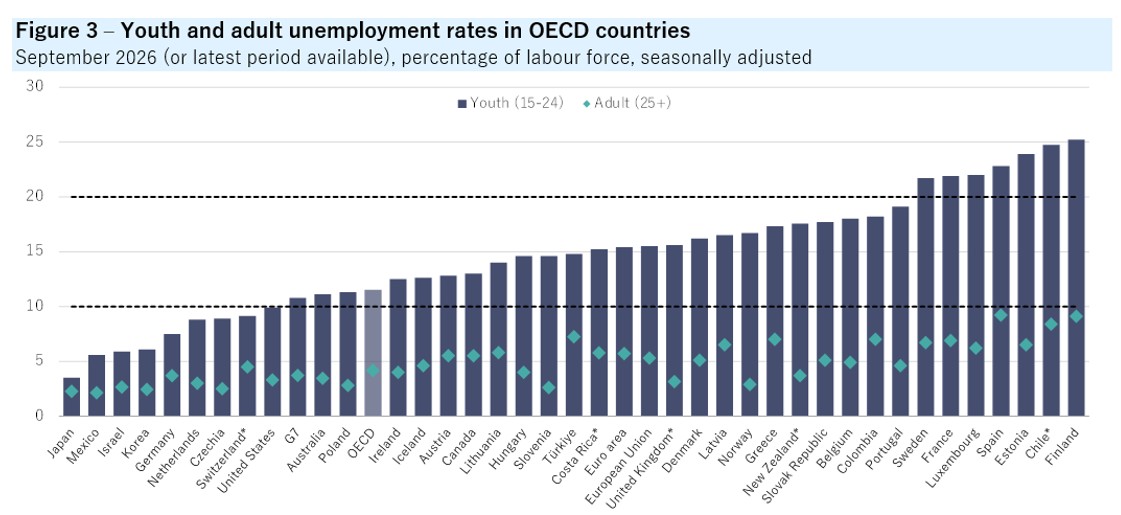
The unemployment rate for 15-24-year-olds in Australia hit a five-year high of 11.1 percent in September, 2026.
Overnight the OECD released figures showing youth unemployment is now in double digits in 29 countries.
Even more disturbing, the rate has gone above 20 percent in France, Chile, Estonia, Finland, Luxembourg, Spain, and Sweden.
It is probably no coincidence that this has coincided with student unrest in many of these countries. This week 49 schools were blockaded in France amid ongoing violence and attacks on teachers and officials.
Youth unemployment has been hard to turn around
The trend is particularly worrying given the difficulties global economies have faced in recent decades turning around high youth unemployment rates.
It also comes as artificial intelligence is being adopted at pace, and in the early stages many of the first jobs it displaces will be basic jobs previously held by graduates.
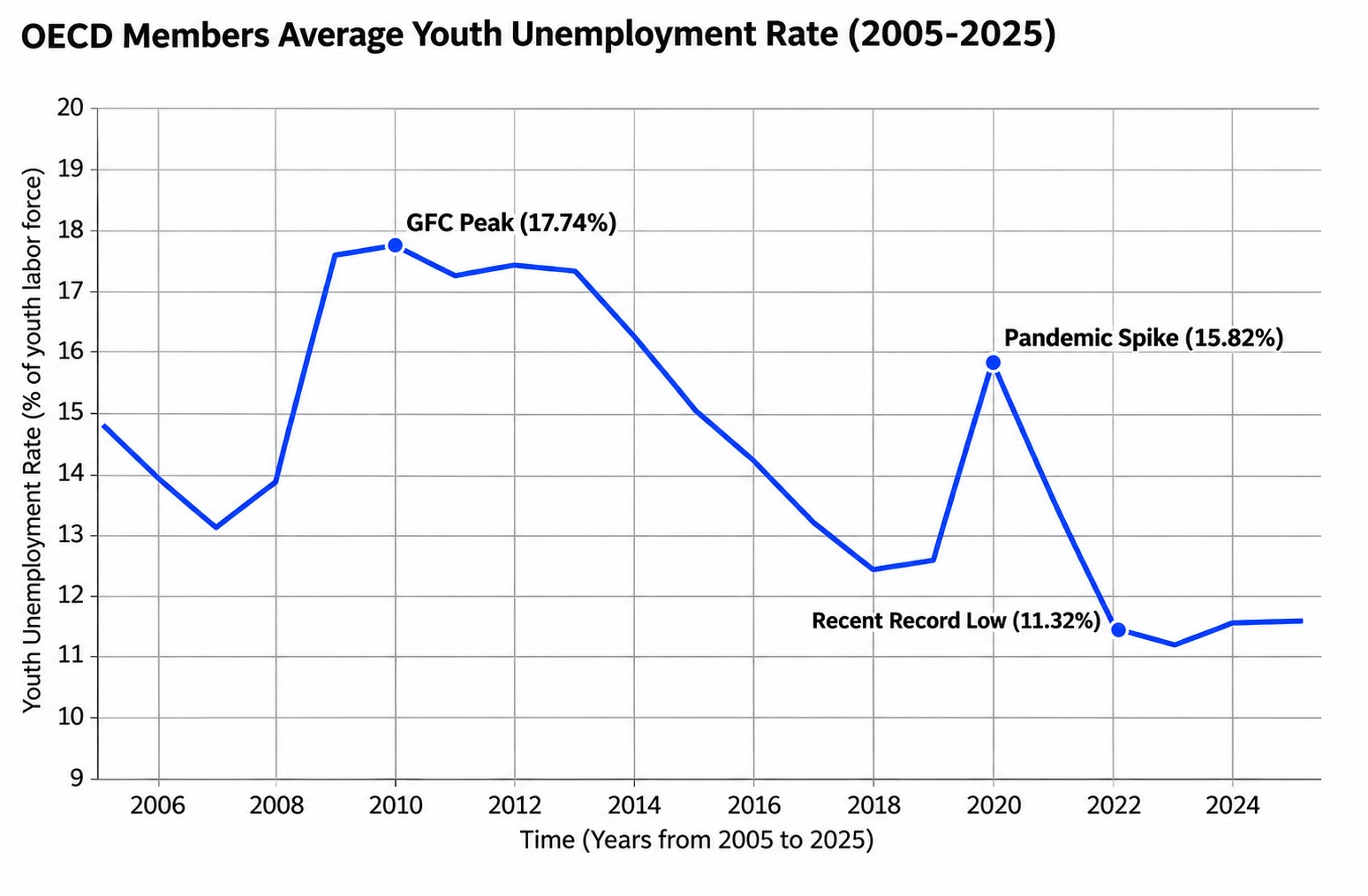
Going back 20 years, youth unemployment across the OECD averaged around 15 percent. It began to improve but was still above 13 percent when the Global Financial Crisis hit in 2008-09, which took it to a peak of 17.74 percent.
Corporate restructuring coming off that crisis meant that, while most job groups came out of the GFC in relatively good shape – relatively quickly – youth employment was slow to recover, taking a decade to return to pre-GFC levels.
Youth unemployment in the OECD was still in double figures when the COVID pandemic caused another global spike. This time recovery was quicker and, up until 2023, looked headed back to single figures.
Until recently.
Some worrying signs
The improvement has stalled and the most recent OECD and Australian figures point to a rising youth unemployment rate, again off a base still in double digits.
Australia’s youth unemployment rate averaged nearly 13 percent between 1978 and 2026, going as low as 7.1 percent in 2022 and as high as 20.10 percent in the recession of 1992.
Worryingly, young people accounted for 64 percent of the growth in numbers of unemployed people in Australia between September 2025 and September 2026.
This is compounded by the fact that youth underemployment is tracking 1.5 times higher than the rate for the general population.
This points again to this age cohort suffering disproportionately during tighter economic times.
Early signs of AI impact
It could also be the beginning of a major tech-driven change in the job market that will again leave many young people adrift and disillusioned.
The Reserve Bank has already alluded to early signs of this trend. Anglicare’s 2025 Job Availability Snapshot showed that entry-level jobs make up just 11 percent of all vacancies – the lowest share in a decade.
Australia needs to look carefully at what is happening in Europe.
While it might be smart long-term business to keep employing young people even when AI is taking much of their work, the reality will likely be far different.
Unfortunately, graduate jobs are often the easiest to cull.
With higher interest rates, cost challenges and uncertain global economic headwinds, many corporations are preparing for redundancies and investing big in automation to reduce future labour imposts.
They are not charities and will not employ young people for the sake of it.
This is a major, emerging socioeconomic problem that requires a rethink of how we transition young people to work.
The traditional pathways have become messy, and even broken.
It is time for a new deal and a new plan. Young people taking on big education debts will need some assurance that the investment is worth it.
What can we do?
It is no coincidence that countries such as Germany, Switzerland, Israel, South Korea and the Netherlands, which have maintained single-digit youth unemployment, have structured school-to-work pathways, integrated technical training and national transition frameworks.
In an AI world, humans need to prepare for different roles and economies need to restructure around new demarcations between people and machines.
Governments need to show clear leadership in managing the fall-out of this level of structural change, which is likely to happen quicker than previous technological transitions.
The market will sort it eventually, but the employment collateral damage along the way could be unprecedented.
Idle young people are a lose-lose for everyone. France will just be the beginning.
Shane Rodgers is a former Queensland Head of Australian Industry Group and author of Worknado – Reimaging the way you work to live.
Newsreel