By Michelle Grattan
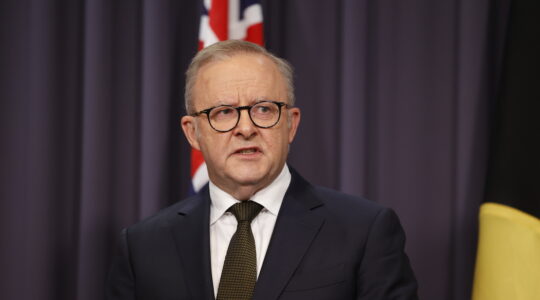
Prime Minister Anthony Albanese has capitulated on the most controversial part of his omnibus post-Bondi bill to minimise political damage and maximise his chances of salvaging what he can at parliament’s special sitting on Tuesday.
His Saturday announcement that he would scrap the proposal to criminalise racial vilification comes as polling shows the Prime Minister and his government taking a big hit in the wake of their responses after the December 14 Bondi attack, which left 15 innocent victims dead.
The Resolve Political Monitor, published on Sunday night by Nine, showed Labor’s primary vote down 5 points in a month to 30 percent. This is its lowest since February 2025.
The Coalition’s primary vote increased just 2 points to 28 percent. One Nation performed strongly, rising to 18 percent. Labor’s two-party lead shrank from 55-45 percent in December to 52-48 percent.
Albanese’s net performance rating plunged from plus 6 in early December to minus 22. His lead as preferred prime minister over Opposition Leader Sussan Ley has narrowed by 11 points and is now 33 percent-29 percent.
Some 56 percent thought Albanese’s response to the Bondi attack was poor; 53 percent rated Ley’s response as good.
Meanwhile the first Newspoll for 2026, also published Sunday night, showed support for both Labor and the Coalition dropping since November. The poll has One Nation on 22 percent, above the Coalition which has a primary vote of 21 percent. Labor’s primary vote is 32 percent, with Labor ahead on a two-party basis 55-45 percent.
Both polls underscore that a vast number of Australians are now dissatisfied with the major parties. Newspoll says that Labor and Coalition combined are now registering the lowest support in the poll’s history, with nearly half (47 percent) backing minor parties and independents.
The dropping of the vilification measure is Albanese’s second embarrassing retreat this month. Earlier, public pressure forced him to call a royal commission into antisemitism, after holding out against one.
Albanese will be able to pass the gun reform part of the original package – including an expensive buyback plan – with the backing of the Greens. The Nationals are firmly against the gun changes.
The key measures now up for negotiation with the Coalition include migration and hate crime-related provisions, including to facilitate the banning of extremist organisations, such as Hizb ut-Tahrir, that promote hatred on the basis of race. There was still no deal done late Sunday, with shadow cabinet having a meeting scheduled on Sunday evening to consider its position.
Once the Greens said late last week they would not support the legislation in total at this week’s special parliamentary sitting, Albanese quickly threw in the towel on the section that would have outlawed racial vilification.
Ley had already described the omnibus bill as “pretty unsalvageable”.
Opposition figures attacked the anti-vilification provision as limiting free speech. This was despite the Coalition having said Labor should implement in full the report of the envoy on combating antisemitism, Jillian Segal, who recommended action on vilification.
Albanese made it clear this measure will now be abandoned entirely – it will not be revived later.
The Executive Council of Australian Jewry co-chief executive, Peter Wertheim, on Sunday expressed concern the dropping of the proposed vilification offence would send a message that the “deliberate promotion of racial hatred is not considered serious enough to be criminalised”.
“How much worse do things need to get before we as a nation finally have the courage to tackle the deliberate promotion of antisemitic hatred that is the heart of the problem,” Wertheim said.
“We exhort the major parties to work together to get legislation passed now that will advance us further down the road towards having effective laws against the deliberate promotion of racial hatred.”
The Australian Federation of Islamic Councils, while welcoming the retreat on the vilification measure, expressed concern about what was still proposed.
Council president Rateb Jneid said: “When power to outlaw organisations rests on secret evidence and political discretion, it stops being about the law and becomes ideology and politics with the force of the state behind it”.
Parliament will devote Monday to condolences following the Bondi massacre. On Thursday, Australia will have a national day of mourning.
Michelle Grattan is a Professorial Fellow, University of Canberra. This article was first published by The Conversation.