By Shane Rodgers
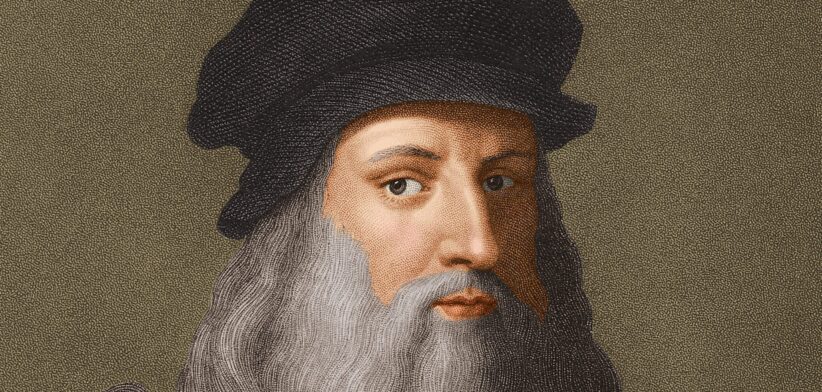
The secret to the creative genius of Leonardo da Vinci may be unlocked through an extensive genetic mapping exercise.
Researchers have tracked Da Vinci’s family across 21 generations, identified living male descendants and confirmed shared DNA markers that stretch back to the Renaissance.
There have also been excavations at a family tomb in Vinci that could provide ancient remains for comparison.
This raises the possibility of reconstructing Leonardo’s genetic profile.
According to a report in Science Daily, the research could “reveal secrets behind his genius” and possibly verify his artworks.
Leonardo da Vinci was an artist, inventor, and thinker whose talents were regarded as being far ahead of his time. The Leonardo DNA Project is trying to discover why.
A newly published book, Genìa Da Vinci. Genealogy and Genetics for Leonardo’s DNA, brings together three decades of research led by Alessandro Vezzosi and Agnese Sabato of the Leonardo Da Vinci Heritage Association in Vinci.
During the research, 15 living male descendants were linked directly through the paternal line to Leonardo’s father and his half-brother, Domenico Benedetto.
Researchers have also identified a Da Vinci family tomb at the Church of Santa Croce in Vinci.
“Archaeological excavations are currently underway in collaboration with the University of Florence,” Science Daily said.
“The site is believed to contain the remains of Leonardo’s grandfather Antonio, his uncle Francesco, and several half-brothers, Antonio, Pandolfo, and Giovanni.”
The report said the if the Y chromosome from these remains matched that of living descendants, it would strengthen historical records and family lineage reconstructions.
“It could also make it possible to analyse biological traces connected to Leonardo himself, including material left on manuscripts or artworks, potentially enabling scientists to reconstruct his DNA,” the report said.
The Leonardo da Vinci DNA Project began in 2016 and is coordinated from The Rockefeller University in New York.
“Our goal in reconstructing the Da Vinci family’s lineage up to the present day, while also preserving and valuing the places connected to Leonardo, is to enable scientific research on his DNA,” Mr Vezzosi said.
“Through the recovery of Leonardo’s DNA, we hope to understand the biological roots of his extraordinary visual acuity, creativity, and possibly even aspects of his health and causes of death.”
The full report is available here