By Chris Wallace
Writer Blanche d’Alpuget has died aged 82, leaving a lasting imprint on Australian literature, and having influenced the course of political history with her pathbreaking 1982 book on the then prime ministerial aspirant, Bob Hawke.
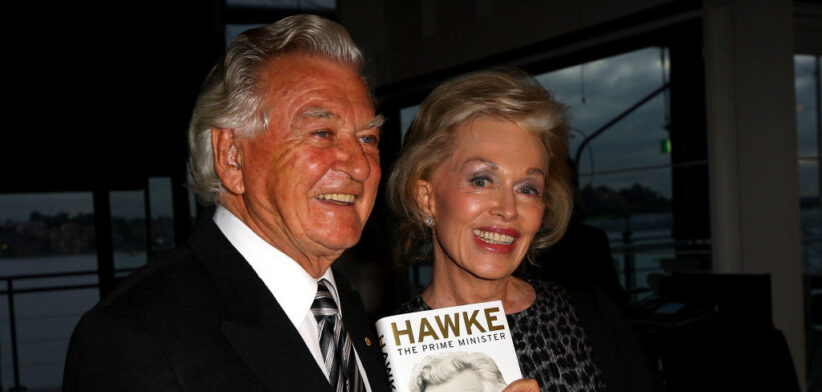
Now deeply fused in the public mind with Hawke, d’Alpuget was already an acclaimed writer with significant star power of her own before becoming publicly associated with him through that book, and later through marriage – the second for both.
d’Alpuget was the daughter of Sydney Sun journalist Lou d’Alpuget, who once shouted so hard at then cadet journalist John Pilger for getting facts wrong that Pilger fainted.
Blanche grew up in Sydney’s eastern suburbs and was educated at Sydney Church of England Girls Grammar School (SCEGGS) and the University of Sydney.
She became a journalist on the Sun’s rival tabloid newspaper, the Daily Mirror, in the early 1960s, working alongside fellow journalist Anna Torv who would later become the second Mrs Rupert Murdoch.
When tyro journalist Laurie Oakes graduated from Sydney University and joined the Mirror, he sat between d’Alpuget and Torv in the Mirror’s Holt Street newsroom.
“She and Anna were each charged with showing me the ropes, showing me how to do it,” Oakes said.
The manuscript of d’Alpuget’s first novel, Monkeys in the Dark, was written while living in Indonesia where her first husband, journalist turned diplomat Tony Pratt, was posted in the early 1970s.
Rejected by publishers, d’Alpuget turned to short story writing. She returned to Australia to live in Canberra, where Pratt continued work as a public servant and she became active in the women’s movement.
Friend, fellow feminist activist and later Hawke government minister, Susan Ryan, described d’Alpuget as vivacious and unconventional. “Dazzlingly pretty and petite, she looked like a Thai beauty with blond curls,” Ryan wrote in her memoir Catching the Waves:
Blanche was full of fun. She liked to make loud, outrageous observations about people, particularly about their sexual demeanour […] In an era of dull and careless feminist dress codes she was a welcome sight at (Women’s Electoral Lobby) meetings, a little bird of paradise in gold high-heeled sandals, tight black slacks and a mink jacket to keep out the Canberra cold, her face luminous with detailed make up.
d’Alpuget’s short story turn worked. She won Fellowship of Australian Writers prizes for two of them in 1975.
A friendship with Sue Kirby, daughter of Arbitration Commission president Richard Kirby, serendipitously led in 1977 to the publication of her first book, Mediator: A biography of Sir Richard Kirby.
Kirby had personally known Sukarno, president of Indonesia (1945–67), and d’Alpuget, as she later wrote, was an “observer in the last days of (Sukarno’s) shattered dream”. It was a shared bond that created a strong chassis for the biographer-subject relationship that resulted in a critically acclaimed book.
d’Alpuget’s stepmother, journalist and editor Tess van Sommers, critiqued draft chapters of the Kirby manuscript. In d’Alpuget’s view it was this, along with the input of Melbourne University Press publisher Peter Ryan, that forged her as a writer.
She then reworked her Monkeys in the Dark manuscript, found a publisher and won the Sydney PEN Golden Jubilee Award for her first novel.
Her second novel, Turtle Beach (1982), won the Age Novel of the Year Award and the South Australian Government Award for Fiction.
d’Alpuget brought knowledge and insight from her years living in Asia to both books: Monkeys in the Dark is set in Indonesia and Turtle Beach is set in Malaysia.
The Hawke biography
Her fourth book – and second biography – Robert J. Hawke: A Biography – is arguably the best political biography in Australian literary history.
After a successful career as President of the Australian Council of Trade Unions, Hawke was elected to federal parliament in 1980, where he became a poorly performing Labor shadow minister under Opposition Leader Bill Hayden.
A heavy-drinking philanderer with little feel for effective parliamentary performance, Hawke was a man drifting towards an unfulfilled destiny, despite the best efforts of Labor’s NSW Right faction to install him in the Labor leadership.
d’Alpuget took a psychoanalytical approach but wrote in an accessible manner, giving the book a wide and enthusiastic audience as it zeroed in on – rather than avoiding – Hawke’s sins and shortcomings as a husband, father and man.
She confronted Hawke with elements of his life he had avoided through alcohol-fuelled carousing, and induced him to deal with his demons while she researched and wrote the biography.
“Only when they’d read the book did (people) realise he was actually a great man,” d’Alpuget said. “Because all they’d seen before was a drunken lout, a drunken larrikin.”
Hawke found salvation in d’Alpuget’s unusual approach, which enabled him to give up drinking and prepare seriously to occupy Australia’s top office. The biography was published in 1982, and in March 1983 Hawke won the election that made him prime minister.
“No-one has ever been as lucky in their biographer as Bob Hawke,” he said.
Loving (and rewiring) Bob Hawke
d’Alpuget and Hawke first became lovers when she interviewed him in 1976 for her biography of Richard Kirby, before whom Hawke had appeared as an industrial advocate.
Hawke, long married to wife Hazel with whom he had four children, proposed marriage to d’Alpuget in 1978.
He reneged in 1979 after deciding the potential political damage of divorce was too high a price to pay, driving d’Alpuget to both suicidal and homicidal thoughts.
Having bills to pay, and making no headway with a proposed biography of former ACTU president Albert Monk, d’Alpuget decided to write one of Hawke, which would be published with great success by independent Melbourne publisher Morry Schwartz.
After launching the book with Hawke’s co-operation, d’Alpuget broke with Hawke and left Australia for some time. Her next book was a novel, Winter in Jerusalem (1986).
The relationship resumed later in life, and they married in 1995. d’Alpuget ceased writing for some time before resuming with a long series of historical novels based on the Plantagenets.
d’Alpuget will be remembered best for her extraordinary Hawke biography, which she described as “internally strong”.
“I was actually thinking of the architecture of a Congregationalist church I’d seen in South Australia when I was writing it: well-proportioned stone, four-square,” she said.
In her research and writing for the Hawke biography, d’Alpuget did a fair amount of rewiring of her subject, to his immense benefit. In the process she put her subject on firm psychological foundations for one of 20th-century Australia’s most successful prime ministerships.
Chris Wallace is a Professor, Canberra School of Government, University of Canberra. This article was first published by The Conversation