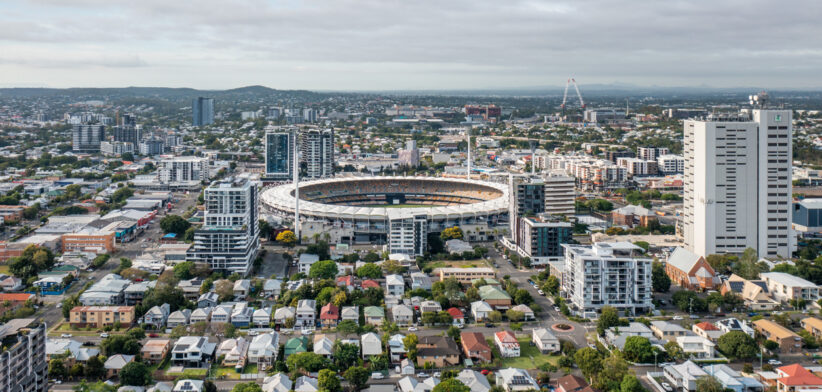
Queensland is acting to protect its international cricket games by developing a hybrid wicket at The Gabba that can be transferred to the new Brisbane Stadium.
The wicket should allow Brisbane Stadium to host international cricket immediately after the 2032 Olympic and Paralympic Games.
As part of the process, a “tray” will be installed alongside the current wicket block at The Gabba in the next few weeks where it will be curated and trialled in the lead up to 2032.
“The new wicket will use the same dimensions, clay base, soil and turf as the existing Gabba wicket ensuring proven, international-standard wickets are available for immediate use,” the Queensland Government said in a statement.
“Importantly, this is the first step towards a world-leading hybrid wicket model at the new Brisbane Stadium.”
The following is the timeline:
2026: A full-sized wicket tray will be installed at The Gabba alongside the existing wicket block in September.
2027-28: The new wicket will be monitored and trialled during practice, intra-squad and lower-profile domestic matches.
2028-29: The wicket will be tested under First-Class cricket conditions.
2032: Following the Brisbane 2032 Olympic and Paralympic Games, the contemporary wicket will be transferred to Brisbane Stadium.
2032-33: The wicket is expected to be ready to support the first international cricket season at Brisbane Stadium.
Premier David Crisafulli said Queensland risked international cricket for nearly five years if the state did not act now.
“This plan is essential to ensuring Queensland can continue to host cricket at The Gabba up to and including 2032 and then relocate to the new Brisbane Stadium in readiness for the 2032-33 international cricket seasons,” he said.
Minister for Sport and Minister for the Olympic and Paralympic Games Tim Mander said the Government wanted to ensure The Gabba’s cricketing legacy lived on well beyond 2032.
“Installing contemporary wicket infrastructure at The Gabba now will allow it to be tested and refined over several years, before being installed at Brisbane Stadium at the end of Brisbane 2032, allowing us to move straight into hosting Test matches,” he said.
“We’re also determined to ensure Queensland is the home of sport in Australia, cricket plays a big part in that.”
Stadiums Queensland CEO Todd Harris said the organisation was well-placed to deliver the infrastructure.
“Transferring proven wickets between Test venues has never been done before, but ingenuity is needed, now, to ensure we don’t miss out on international cricket until 2035-36,” he said.
The Gabba Grounds Manager David Sandurski said he was invested in preserving the unique history and cricket characteristics of The Gabba.
“It’s important we get this right, so we’ve explored a range of wicket block practices and technologies at venues across Australia and New Zealand, including the critical elements like tray design, clay type and depth, and turfing method,” Mr Sandurksi said.
“The new wicket will replicate both the dimensions of existing wickets and the make-up, with the same clay base, soil and turf, so we’ll be looking to refine it over time to reproduce the same pace and bounce The Gabba is famous for.”