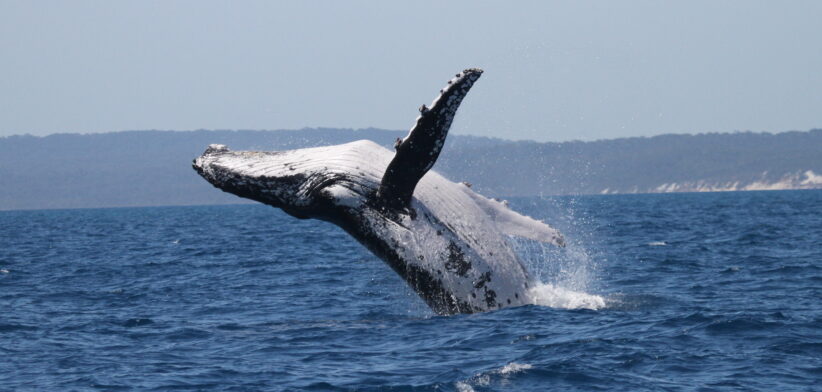
Humpback whales have been found to travel more than 14,000km between breeding grounds.
Research released today documented a new record for the greatest distances confirmed between sightings of individual humpback whales.
An international team of scientists has confirmed at least two whales have travelling between breeding grounds in eastern Australia and Brazil.
Griffith University PhD Candidate and research co-author Stephanie Stack said that, by comparing tens of thousands of photographs of whale tails, the team identified the two whales in photographs taken in both countries.
“These whales were photographed decades apart, by different people, in opposite parts of the world, separated by two different oceans, and yet we can connect their journey,” she said.
One whale was first photographed in Hervey Bay, Queensland in 2007, and was seen again in the same area in 2013 before turning up off the coast of São Paulo, Brazil in 2019.
“These two breeding grounds are separated by a minimum straight-line ocean distance of about 14,200km – roughly the distance from Sydney to London,” the researchers said in a statement.
“Because only the start and end points of the whale’s journey were documented, the actual route taken, and therefore the true distance swum, remains unknown.”
The other whale was first photographed in 2003 at the Abrolhos Bank –off the coast of Bahia, Brazil.
“Twenty-two years later, in September 2025, it was spotted alone in Hervey Bay, Australia, representing a travel distance of 15,100km, making this the longest distance ever documented between sightings of the same individual humpback whale on record,” the researchers said.
The study drew on 19,283 photographs collected between 1984 and 2025.
The researchers said these long breeding commutes appeared to be rare.
In more than 40 years of data covering nearly 20,000 individual whales, only two such animals were found, representing just 0.01 per cent of identified individuals.
The study ‘First evidence of bidirectional exchange between distant humpback whale breeding populations in eastern Australia and Brazil’ has been published this week in Royal Society Open Science.