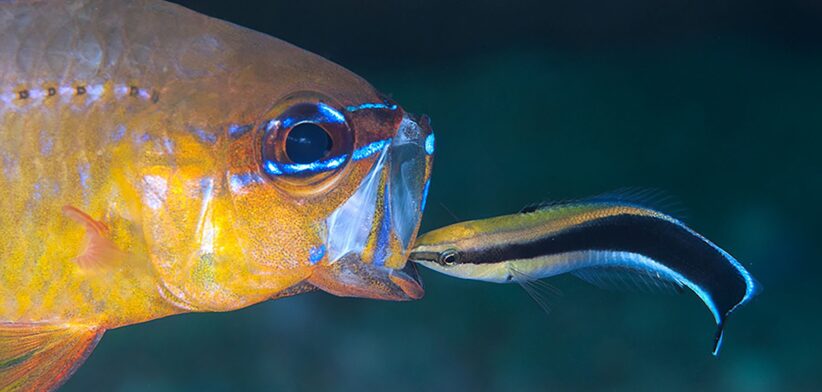
A newly discovered fish species is operating underwater “beauty salons” in Australia’s coral reefs.
The two new-to-science species of the Cleaner Wrasse genus (Labroides) run dedicated “cleaning stations” where larger fish literally queue to be serviced.
Cleaner wrasses perform critical ecological services on coral reefs by removing parasites, dead tissue and debris from larger reef fish.
The cleaning services are so vital that experimental removal of cleaner wrasses from reef systems has been shown to reduce the health and diversity of fish communities.
Australian Museum Curator of Ichthyology Dr Yi-Kai Tea said the discovery of the Goldenrod Cleaner Wrasse (Labroides inopinatus) and the Cinnabar Cleaner Wrasse (Labroides flammulatus) had been difficult because the species had similar colours and behaviours, making it difficult to tell them apart.
Dr Tea and Queensland Museum Principal Scientist Dr Peter Cowman were able to make the discovery using genetics and micro-CT scanning techniques.
“By using advanced phylogenomic techniques, we’ve been able to reveal the true evolutionary history of these fish in much higher resolution,” Dr Cowman said.
“It’s like putting on a new pair of glasses – suddenly species that were indistinguishable have become distinct.
“This discovery shows that even our most iconic reef residents still hold genomic secrets that can only be unlocked through high-tech analysis and institutional collaboration.”
The Goldenrod Cleaner Wrasse (Labroides inopinatus) takes its species name from the Latin for “unexpected”, a nod to its surprising discovery, found between 40 and 145 metres below the surface of the water.
It is one of only a handful of cleaner wrasses documented at these depths, suggesting that cleaning stations, traditionally considered a feature of shallow reef life, might play an important ecological role even in deep reefs.
Most cleaner wrasses operate in the sunlit shallows, but the Goldenrod Cleaner Wrasse is a specialist of the mesophotic zone: the reef’s ‘Twilight Zone’.
The Cinnabar Cleaner Wrasse (Labroides flammulatus) draws on the Latin term for “bearing a small flame,” in recognition of its distinctive orange-brown markings.
The Cinnabar was awarded its name by school students who attended the Australian Museum’s annual Sydney Science Trail event in 2023.
“Connecting young students to the naming of this vibrant and well-loved fish means they are now part of the story of this species forever,” Dr Tea said.
“I hope they are as thrilled as we are with the discovery and perhaps it might inspire a few to also learn more about our incredible oceans.”
The specimens used to describe the new species are a part of the Australian Museum’s Type collection, where they will remain as part of the reference collection for further study and research.