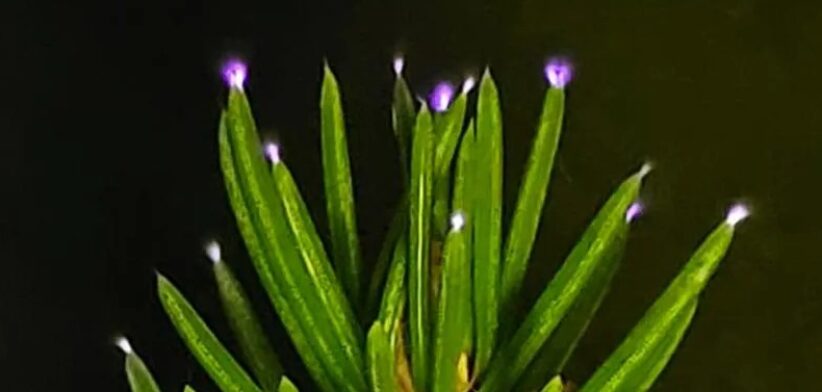
Faint electrical glows shimmering from treetops have been captured by storm-chasing scientists.
Penn State University researchers say these “corona discharges” were long suspected to exist but had never been observed outside a lab.
They appeared as tiny UV flashes at the tips of leaves, and may help reshape the understanding of forests and how to break down pollutants
The images were captured from a converted 2013 Toyota Sienna fitted with a hand-built telescopic weather device protruding from the roof.
“They (the researchers) were hoping to catch corona discharges, a long-hypothesised atmospheric weather phenomenon where miniscule pulses of electricity dance at the tips of tree leaves, causing the canopy to glow in the ultraviolet (UV),” the research report said.
“For more than 70 years, scientists have suspected treetops might emit these corona electrical discharges because of odd electric field activity in and over forests during storms, yet they have never been documented outside the lab.”
Near the end of a two-hour thunderstorm in Pembroke in the US, the researchers observed and recorded corona on a long needle loblolly pine tree.
“This just goes to show that there’s still discovery science being done,” doctoral candidate in meteorology and atmospheric science Patrick McFarland.
“For more than half a century, scientists have theorized that corona exists, but this proves it.”
The research team said that corona discharges took shape during storms because clouds build up strong negative charges that attracted the opposite positive charge on the ground below.
“Opposites attract and this positive electrical ground charge rises up through the trees to the highest point,” the report said.
“(This causes) an electric field on the tiny, hair-like tips of leaves that is great enough to create the weak corona glow in both visible and UV form.”
The team’s prior research found corona discharges to be a substantial source of atmospheric cleansers in the forest canopy.
The full report is here