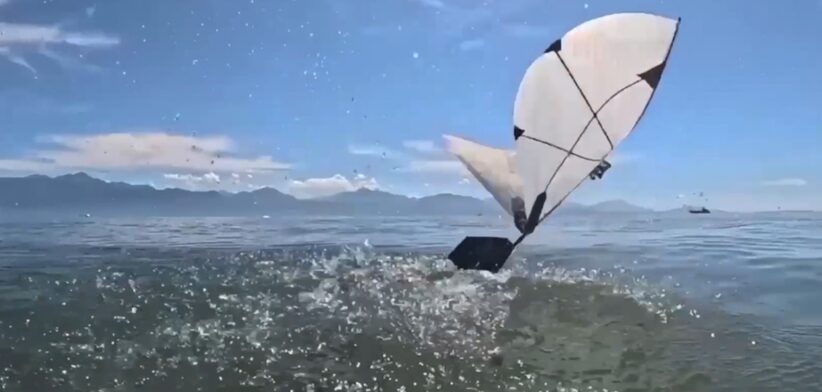
Researchers have developed a winged robot that can mimic sea birds and has the potential to explore vast areas of ocean above and beneath the surface.
MIT Assistant Professor of Mechanical Engineering Raphael Zufferey said scientists were inspired by “aquatic aviators” and designed a robot that can swim underwater, then flap out of the water to continue flying through air, much like diving birds.
Professor Zufferey said the “flapping-wing aerial-aquatic vehicle,” or FAAV, weighed less than 300 grams and was designed to help scientists study the mechanics that enable diving birds to fly through air and water.
He said the robot had a central body, or fuselage; two flexible, flapping wings; and a steerable tail.
Professor Zufferey said the team envisioned such winged robots could be deployed in oceanography to fly to and sample from aquatic regions that would otherwise be too dangerous for traditional ocean vessels to access.
“Our dream vision is for oceanographers, marine biologists, and members of coastal communities to launch this robot from a boat, or from shore, and it would fly close to the area of interest, such as an iceberg or a port facility, or over a pod of whales.
“It would dive into the water to take a measurement or collect a sample, and fly back to deliver the data at a fraction of the cost of traditional methods. Then it could go back out to dive for more.”