A “cosmic volcano” has erupted in deep space as a colossal black hole reawakens after 100 million years.
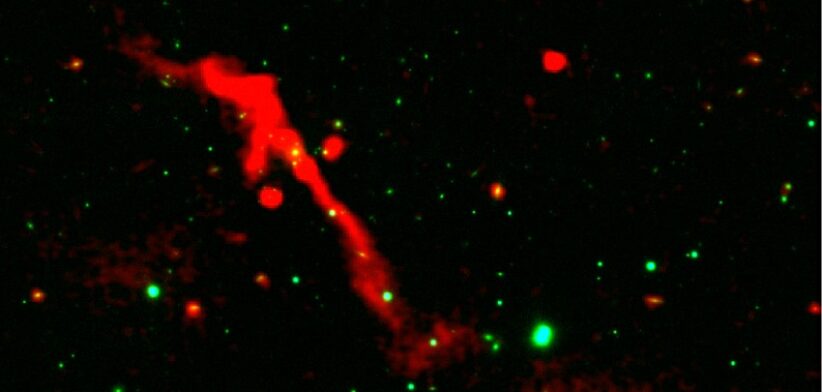
The Royal Astronomical Society said radio images revealed the galaxy locked in a “messy, chaotic struggle between the black hole’s newly ignited jets and the crushing pressure of the massive galaxy cluster in which it resides”.
Lead researcher Shobha Kumari, of Midnapore City College in India, said the images showed a compact, bright inner jet, which was an “unmistakable” sign of the black hole’s recent awakening.
“Just outside it lies a cocoon of older, faded plasma – leftover debris from the black hole’s past eruptions, distorted and squeezed by the hostile environment around it,” she said.
“It’s like watching a cosmic volcano erupt again after ages of calm – except this one is big enough to carve out structures stretching nearly a million light-years across space.
“This dramatic layering of young jets inside older, exhausted lobes is the signature of an episodic AGN – a galaxy whose central engine keeps turning on and off over cosmic timescales.”
The research, published this week in Monthly Notices of the Royal Astronomical Society, was based on information received through highly sensitive radio signals collected in the Netherlands and India.
“Most galaxies host a supermassive black hole, but only a few produce vast jets of radio-emitting magnetised plasma,” the research report said.
“J1007+3540 ((the galaxy involved) is unique…because it shows clear evidence of multiple eruptions – proof that its central engine has turned on, shut down, and restarted after long periods of quiet.”
The J1007+3540 galaxy lives inside a massive galaxy cluster filled with extremely hot gas.
“Systems such as J1007+3540 are extremely valuable to astronomers,” the report said.
“They reveal how black holes turn on and off, how jets evolve over millions of years, and how cluster environments can reshape the entire morphological structure of a radio galaxy.”
The full report is available here.