Every shallow-water coral reef in Australia is facing an “extremely high” risk of collapse by 2075, an international assessment project has concluded.
More than 250 researchers found that 96 percent of the world’s assessed coral reef ecosystems were now classified as critically endangered.
This included all 17 Australian coral reef ecosystems, among them Queensland’s iconic Great Barrier Reef.
The risk is due to increasing marine heat stress and mass bleaching predicted under future climate scenarios.
University of Melbourne scientific lead of the global assessment, Dr Mishal Gudka, said the risk of coral reef collapse was escalating.
However this should be seen as a wake-up call rather than a cause for despair.
“Coral reefs have shown a remarkable ability to bounce back from devastating bleaching events,” he said.
“Pockets of surviving, resilient coral reefs can remain in the future –but we must do everything within our reach to set them up for success.
“Our assessment shows that much of the risk is driven by projected change that have not yet fully materialised and now is a critical window to scale up conservation and climate efforts to avoid catastrophic loss.”
The research was a collaboration between the International Union for Conservation of Nature (IUCN), the University of Melbourne and CORDIO East Africa.
It evaluated coral reef ecosystems in 127 tropical and subtropical marine ecoregions.
The researchers found that climate-driven ocean warming was the most widespread and severe threat to coral reefs globally.
Oceanwise Australia Director Dr Ben Fitzpatrick, who led the assessment on Australia’s coral reef ecosystems, said that although Australian coral reefs could respond well to local management, these gains were increasingly being overwhelmed by changing climate.
“Unfortunately, these climate change impacts are only expected to intensify under current climate change trajectories, making the risk of collapse for all our coral reefs exceptionally high,” Dr Fitzpatrick said.
“If we double down on local management, and achieve rapid decarbonation we can avoid this outcome, but the window for action is rapidly closing,” he said.
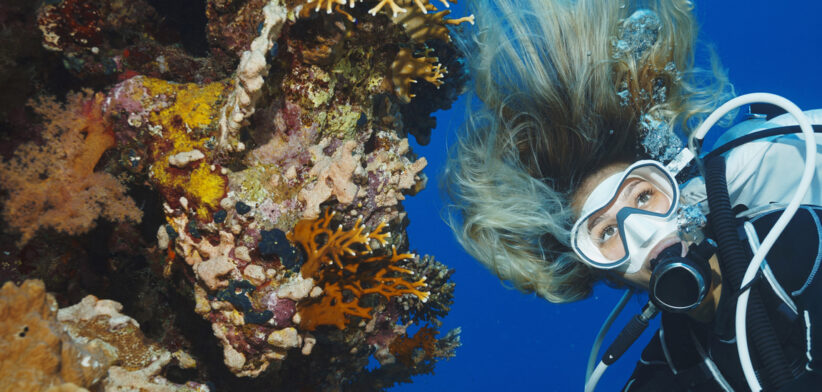
Coral reefs support around a quarter of all marine species.
A coral reef ecosystem is considered collapsed when reef-building hard corals largely disappear and are replaced by algae, rubble and other organisms.