By Shane Rodgers
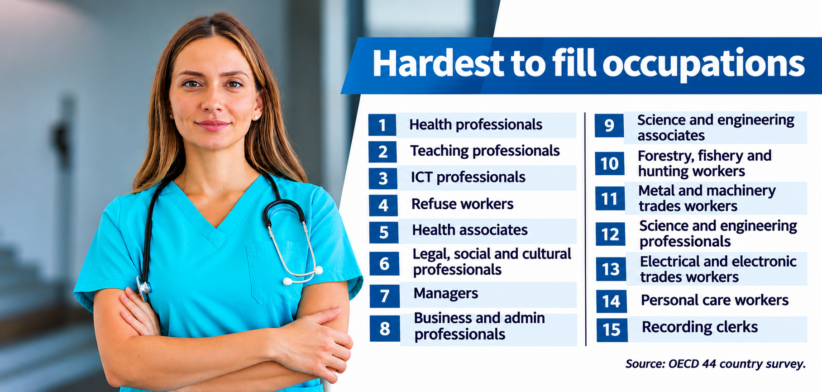
Despite the rise of ultra-high technology, the world’s biggest skills shortages are still largely in health, teaching and trade occupations.
The latest OECD Skills for Jobs report found health and teaching professionals were by far the hardest roles to fill across 44 countries.
ICT professionals are also high on the list, as are personal care workers and managers.
The top 15 also includes metal and electrical trades workers, refuse workers, forestry fishing and hunting workers and science and engineering roles.
The OECD said shortages of some high-skilled workers were accompanied by shortages of cooks, cashiers, waiters and tourism workers.
The OECD’s most recent analysis shows that on average 35 percent of workers have jobs that are mismatched to their qualifications.
“More than seven out of 10 graduates in the field of Humanities and Arts are employed in a job that is unrelated to their specialization,” the report said.
“Similarly, a substantial share of graduates in Science and Agriculture fields also struggle to find employment in those fields (60 and 51 percent respectively).
“A relatively good alignment exists in the field of Social Sciences, Business and Law as well as in Health and Welfare whose graduates are able to find a job matching their fields of specialisation more easily.”
The report said that, while firms struggle to find workers who can operate new tools and technologies, workers have a hard time finding jobs that are a good match for their skills.
It said the jobs at greater risk from automation were the same ones that were already in surplus.
“Vice versa, occupations in critical shortage (where demand is higher than supply) are also those facing the lowest risk of being automated,” the report said.
“The challenges stemming from automation call for targeted policy action designed to equip low-skilled workers with the necessary tools to navigate this changing landscape”
The full report is here
Newsreel