By Shane Rodgers
Australia is relying very heavily on migrants for its talent pool to meet the growing demand for technical and trade skills.
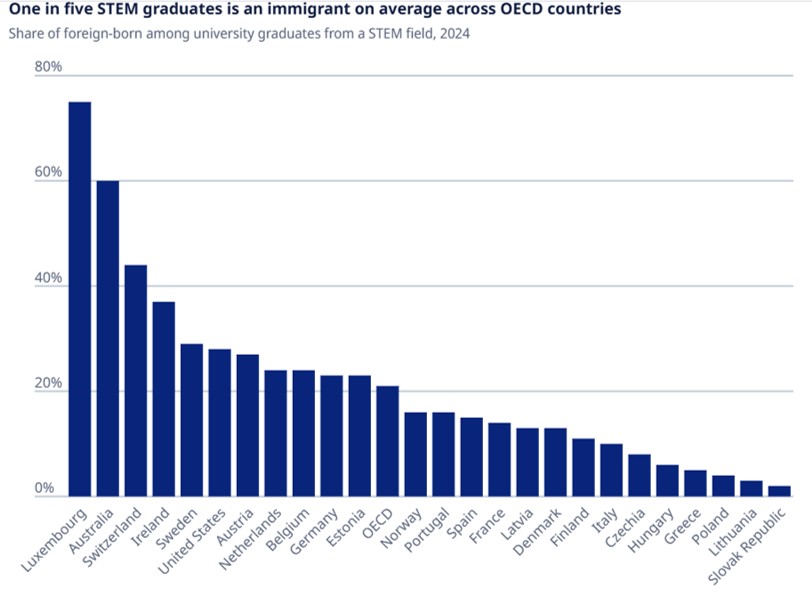
Figures released by the OECD overnight show that 60 percent of university-educated STEM graduates in Australia were born overseas – three times the international average.
This is the second highest of the 25 countries assessed, with only Luxembourg having a higher percentage and only three counties being higher than 40 percent.
The findings are significant given the underlying skills shortages in Australia and the race by major political parties to reduce migration to take pressure off the national housing undersupply.
In May, the Australian Government set the planning level for the 2026‑2027 Permanent Migration Program at 185,000 places, unchanged from 2025‑2026.
Opposition parties are promising even bigger cuts with the Coalition proposing a 100,000 immigration drop annually for two years and One Nation proposing a cap of 130,000 migrants by 2031–32.
The latest Science and Technology Australia STEM analysis predicts that demand for university-qualified STEM jobs will grow by 24 percent by 2035.
The OECD International Migration Outlook 2026, released overnight, said countries across the world were grappling with the challenge of harnessing immigration for economic benefits while mitigating any adverse effects.
Migration to OECD countries declined for second consecutive year, but remains high by historical standards
The report highlighted the importance of STEM skills for adaptive change.
“Workers in areas related to science, technology, engineering and mathematics (STEM) play a key role in productivity growth through research, innovation and the adoption of new technologies,” the report said.
“On average across OECD countries, one in five STEM graduates is an immigrant, a substantially higher share than immigrants represent in total employment.”
Globally, family reunification remained the main reason for permanent migration, accounting for 45 percent of total inflows.
Humanitarian migration fell by 26 percent in 2025.
OECD Secretary-General Mathias Cormann said immigrants accounted for 16 percent of employment across the OECD.
“With ageing populations and slower productivity growth, countries cannot afford to waste the skills migrants bring,” he said.
“That means helping migrants move into jobs where they can contribute most, and giving immigrant entrepreneurs better access to finance, networks and business support.”
International student inflows fell from 1.9 million in 2024 to 1.6 million in 2025, with the decline concentrated in traditional English-speaking destinations.
In contrast, European countries continued to attract growing numbers of international students, especially Austria, Germany and Italy. China and India remained the largest source countries.
In 2025, Australia received 234,000 new immigrants on a long-term or permanent basis (including changes of status), down 2.2 percent from 2024.
More than half of this (53 percent) was migration of family members.
Around 158,000 permits were issued to tertiary-level international students and 312,000 to temporary and seasonal labour migrants.
India, China and the Philippines were the top three nationalities of newcomers in 2024.
The full report is here