Growth in major economies is not translating to higher real wages as inflation and productivity challenges continue to undermine progress.
OECD figures released overnight show that Australia is one of the worst performers in real wages, with a 5.1 percent fall over the past five years (see table below).
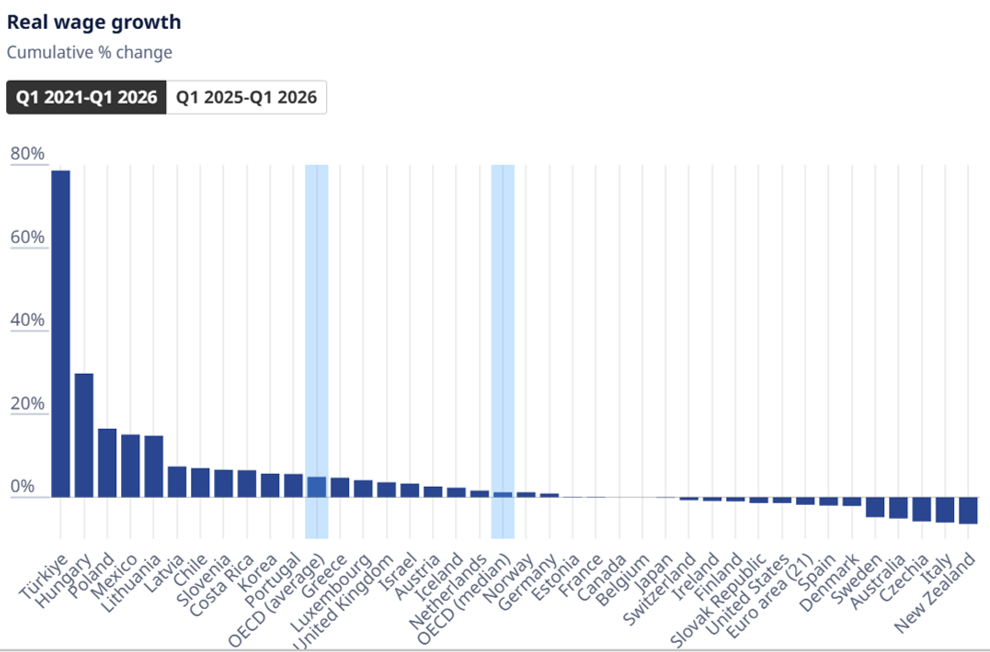
The OECD 2026 Employment Outlook said that real wages across major economies had been growing but at a lower rate than a year ago.
Despite this growth, wages had still not caught up with the 2022 inflation spike in many countries, and real wages (spending value of wages) were being hit again by the recent energy price surge.
The OECD figures came as Treasurer Jim Chalmers warned that the ongoing Middle East conflict and oil market pressures could create another spike in Australia’s inflation rate.
And former Reserve Bank governor Philip Lowe noted last week that the 2020s were on track for the worst decade of living standards growth since First World War.
Mr Chalmers released Treasury advice suggesting that the re-igniting of the Middle East conflict could push inflation above five percent, quashing hopes that the Consumer Price Index was trending down.
Higher inflation will put pressure on the Reserve Bank to raise interest rates at a time when households are struggling due to the real wages situation.
In a speech last week, Dr Lowe said that GDP per person had risen just 4 percent this decade.
This put Australia on course for the slowest living standards growth in more than a century.
Dr Lowe said fundamental policy shifts were urgently needed to spark business investment and reverse the country’s economic sluggishness.
The OECD Employment Outlook said that labour markets had continued to show resilience over the past year.
However, there had been new signs of weakening with a slowdown in the growth in employment and labour force participation.
“The average OECD unemployment rate remained relatively stable at 4.9 percent in May 2026, with around two thirds of OECD countries seeing a slight increase,” the report said. “The average employment and labour force participation rates in the OECD remained at or close to record levels, reaching 72.1 percent and 76.7 percent respectively in Q1 2026.”
The report said young university graduates were at an increasingly high risk of unemployment compared to other workers.
This was linked to a rising trend that began well before the spread of generative AI models, “suggesting more complex root causes”.
Across the OECD there was also a big difference in employment prospects across different regions.
“Where people live shapes their job opportunities, career progression and living standards. Large regional differences within countries carry real economic costs, as underperforming regions fail to reach their potential,” the report said.
These differences also threatened social cohesion when people felt they were falling behind more prosperous areas.
“In over half of OECD countries, employment rates across small regions vary by more than 20 percentage points.
“Crucially, differences in local population characteristics explain only half of this gap at most, with the rest reflected by what places themselves have to offer.”
The full report is here