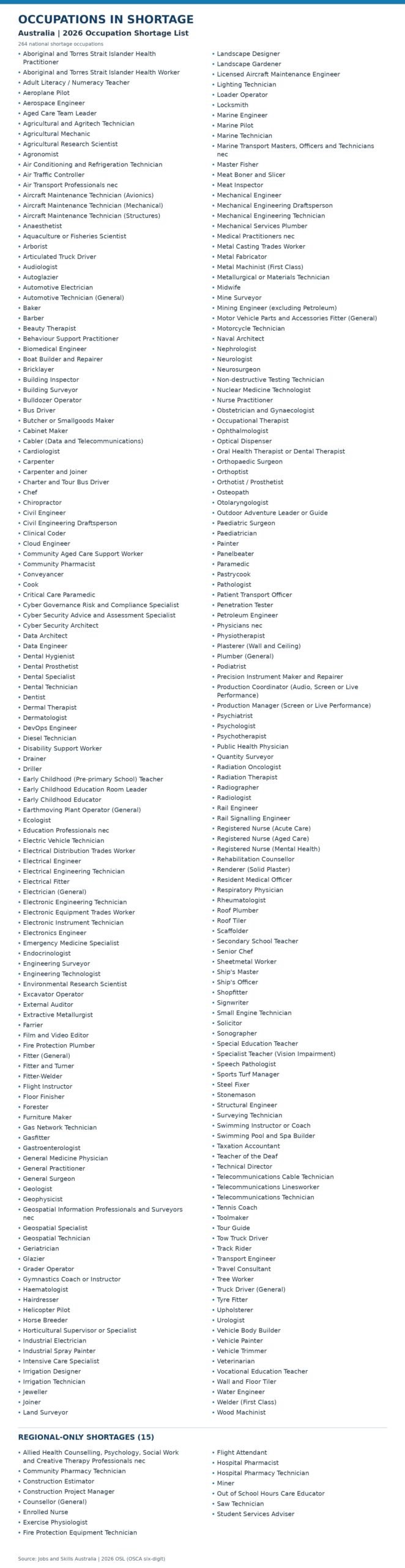
Australia has significantly more occupations experiencing national skills shortages than five years ago, despite an easing in recruitment pressures since 2023.
An analysis of Jobs and Skills Australia data shows 264 occupations were classified as having national shortages in 2026, compared with 173 in 2021.
This was an increase of almost 53 percent.
Over the shorter term, the proportion of occupations with national shortages fell from 29 percent in 2025 to 27 percent this year. This was well below the peak of 36 percent in 2023.
According to the 2026 Occupation Shortage List, over the five years, 118 occupations moved from having no shortage to experiencing national shortages, while 47 moved in the opposite direction.
Persistent shortages remained a challenge, with 127 occupations in shortage continuously from 2021 to 2026.
The areas hardest hit
Healthcare was among the hardest-hit sectors, with dentists, paramedics, radiographers and several nursing specialties moving into national shortage.
Education also faced growing pressures, with secondary school teachers, special education teachers and vocational education teachers among those joining the shortage list.
Transport shortages became more widespread, with truck drivers, bus drivers, pilots and air traffic controllers among the occupations newly experiencing national shortages.
Several engineering and construction occupations also recorded shortages, including aerospace engineers, electronics engineers, building surveyors and scaffolders.
Almost half of technicians and trades occupations and 37 percent of professionals were assessed as being in shortage this year.
Areas of improvement
Software engineers, cyber security analysts, general accountants and management accountants were among those moving out of national shortage.
Some agricultural and care-related occupations also recorded improvements.
A shift in the labour market
The figures highlight a significant shift in Australia’s labour market, with growing demand for workers in essential services, particularly healthcare, education and transport.
Despite the overall easing in the past year, shortages remain concentrated among professionals, and technicians and trades workers.
Analysis by Job Skills Australia showed most of shortfall was due to supply pipeline constraints, a lack of suitable applicants and retention challenges.
“Training was the main driver for motor mechanics, while suitability was the main driver for registered nurses, with training also a significant contributor,” the analysis showed.
The full data report is here