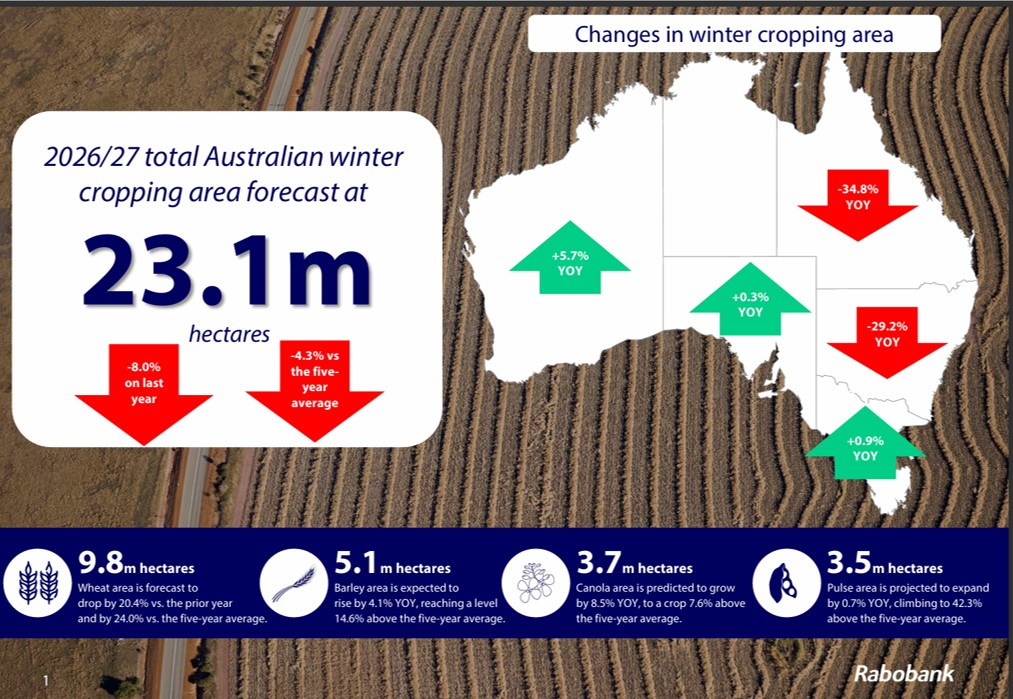
Australia’s winter crop is expected to be reduced this year off the back of mixed weather and increased input costs.
Queensland is expected to have the biggest decline, with a 34 percent drop in the area under crop compared with last year.
The Rabobank 2026-27 Australian Winter Crop Forecast, released today, predicts a 23.1 million hectare national cropping area for the season.
This is down eight percent on last year and 4.3 percent below the five-year average.
“The decline in cropping area is forecast to come at the expense of wheat, with the nation’s wheat planting estimated to be down by a substantial 20.4 per cent on last year to 9.8 million hectares,” the outlook report says.
“This is 24 per cent below the five-year average.”
RaboResearch senior grains and oilseeds analyst Vitor Pistoia said that, in contrast, barley, canola and pulse plantings were forecast to increase on last year’s area.
There are also mixed projections across states:
- Western Australia up by 5.7 percent to a record 9.47 million hectares
- Queensland down 34.8 percent to 1.06 million hectares
- New South Wales down 29.2 per cent to 4.82 million hectares
- South Australia up 0.3 percent to 3.99 million hectares
- Victoria up 0.9 percent to 3.74 million hectares
Mr Pistoia said the disparity reflected the dry conditions experienced across Queensland and northern New South Wales this year, alongside better seasonal starts in Western and South Australia.
“Australia enters the 2026-27 winter cropping season with a more uneven and weather-dependent cropping area than in recent years,” he said.
“The season is opening with a clear geographic split across Australia’s cropping regions. Conditions on the northern east coast, particularly in southern Queensland and northern New South Wales, have been dry through summer and early autumn, leaving limited topsoil moisture and delaying sowing.”
In contrast, Western Australia, South Australia, Victoria and southern New South Wales had entered the season with average to above-average soil moisture, allowing earlier seeding.
The report said elevated farm input costs, particularly higher global fertiliser and diesel prices due to the Middle East conflict, were increasing production costs for Australian growers and influencing cropping decisions this quarter.
“These higher costs are encouraging shifts towards lower-input crops and contributing to a reduction in total cropping area,” Mr Pistoia said.
Looking ahead rising fuel costs were likely to become an increasingly important driver in the global trade outlook.
“This is expected to favour Australian exports into South East Asia, where shorter shipping distances improve competitiveness relative to ‘the Americas’,” Mr Pistoia said.