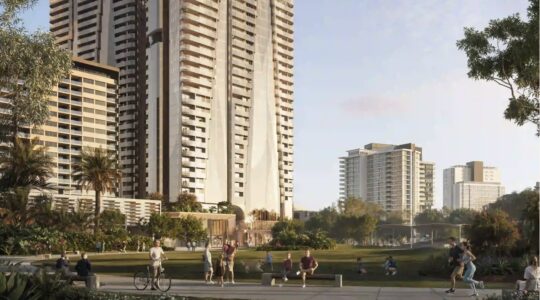
Houses in Queensland are shrinking in size but costing more, and the state now has the highest costs for building new apartments on the East Coast.
A Master Builders Queensland (MBQ) analysis, using ABS data, found the average price for building a new apartment in Queensland was just over $5020 per square metre.
This was a “staggering” 71 percent higher than three years ago.
The increase compared to 24 percent in Victoria and 38 percent in New South Wales over the same period.
“The average cost to build a new detached home in Queensland has jumped by 41 percent since 2021-22, equal highest of any other state or territory over the same timeframe,” Master Builders said in a statement.
“This has resulted in consumers choosing to build smaller homes, with the average floor area now sitting at close to 231 square metres, compared to 245 square metres just a year ago.”
ABS regional building approval figures show 44,689 new detached houses and units were approved in the year to April – an increase of 0.3 per cent on March, and 1.4 per cent for the quarter.
MBQ said this was well short of the government target of 50,000 new dwellings a year.
“These figures confirm what industry has long been saying – the cost to build in Queensland is becoming prohibitive, where increasingly, only higher-end projects stack up financially,” Master Builders Deputy CEO Michael Hopkins said.
“While worker safety and build quality are always our top priority, it’s clear that red tape continues to hold construction back, adding cost and blowing out program times.”
An Australian Housing and Urban Research Institute report released this week found that market volatility was the biggest barrier to lifting housing construction in Australia.
It said boom-and-bust cycles were disrupting labour, costs, timelines and quality across the sector.
An 18-month study, led by RMIT University Associate Professor Andrea Sharam, found that swings in demand could sharply change the number of homes under construction.
In detached housing, a boom year can push the number of homes under construction up by 50,000, while a downturn can reduce that number by 20,000.
With apartments, the 2010s boom drove construction up by almost 300 percent before prudential regulation and the withdrawal of Chinese investment contributed to a 30 percent decline.
“Our ultimate conclusion was market volatility presented the most significant risk for builders, and the biggest constraint on construction output and quality,” Associate Professor Sharam said.
“Booms…draw in marginal operators and under-skilled workers, increase pressure to cut corners, and disrupt work scheduling creating task queues.
“Downturns meanwhile cause some permanent loss of labour, wage suppression, loss of knowledge and innovation, and businesses leaving the sector.”
The full report is here.
Another report released this week concluded that only first homebuyers and institutional investors would benefit from the Federal Government’s recent changes to Capital Gains Tax and Negative Gearing.
Savills Australia’s Residential Research Review for June 2026 found that renters would suffer with reduced vacancies and higher rents, while the average investor would also be hit with lower returns as a result of the tax changes.
The report says institutional investment in the new build market is set to benefit, supported by retained tax concessions and government funding to increase housebuilding.
Investing in established property has become less attractive overall, with the government aiming to level the playing field between first time buyers and buy to let investors.
Key Changes announced in the Federal Budget
Negative Gearing
Investment properties (excluding new build) running at a net loss can no longer be offset against income tax, from July 1, 2027. Established properties purchased prior to May 12, 2026 can continue to be negatively geared.
Capital Gains Tax
The flat 50 percent CGT discount (applied to a seller’s marginal tax rate) on assets held for over 12 months will be scrapped, from July 1, 2027. It will be replaced with a 30 percent minimum tax on gains made above inflation, rising to marginal income tax levels for higher earners. New build purchasers can opt to keep the 50 percent CGT discount, or choose the new model at point of sale, depending on which produces a better tax outcome.
Other influential changes to the market that were in the Federal Budget
Overseas Purchasers
Exclusion from the established property market has been extended to June 2029, but purchase of new build properties remain permitted.
Family Trusts
Typically used by high-net-worth families, will no longer be able to benefit from income splitting, with a minimum 30 percent tax on trust income to come into effect from July 2028.
Support for Supply
$2 billion new funding package for infrastructure will help unlock up to 65,000 homes over a decade.