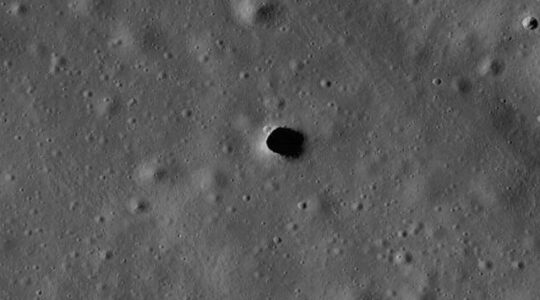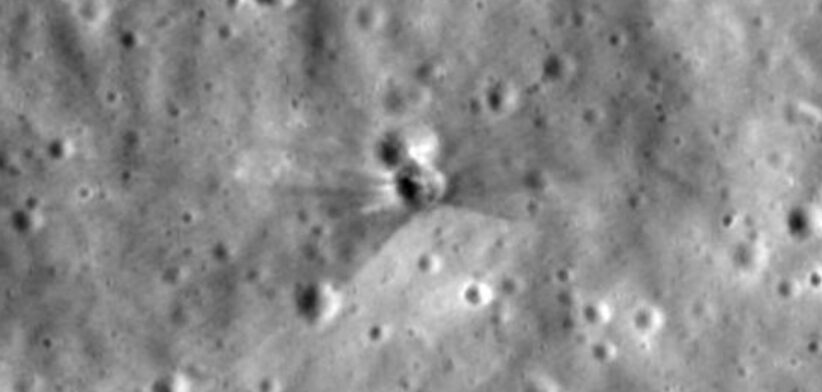
NASA has identified and captured images of the crater formed on the Moon from the crash of part of Elon Musk’s SpaceX Falcon 9 craft.
Images released this week show the new crater, formed on August 5, 2026.
They were captured by NASA’s Lunar Reconnaissance Orbiter (LRO).
“To capture imagery of the impact, engineers tilted the spacecraft so its cameras would point toward the crater each time LRO passed about 60 miles (96km) above the Moon, traveling 1 mile per second,” NASA said in a statement.
“The orbiter circles the Moon from pole to pole every two hours, while the Moon slowly rotates underneath it. To photograph a specific spot, the spacecraft must wait until that location turns into view, which took six days in this case.”
NASA said that finding the impact site took global coordination among experts and hobbyists.
Independent astronomers first identified the rocket’s trajectory using publicly available data.
“NASA’s Center for Near Earth Object Studies, which tracks natural objects that could pose hazards to Earth for the agency’s Planetary Defense program, used this opportunity to test and validate tools and techniques for predicting impacts,” NASA said.
“Based at NASA’s Jet Propulsion Laboratory in Southern California, the centre incrementally refined the trajectory until identifying the location of impact, which it provided to the Republic of Korea for their Korea Pathfinder Lunar Orbiter (Danuri) team.
“The team used the high-resolution LUTI camera on Danuri a few hours later to image the crater, finding the prediction was accurate to about 0.6 miles.”
The SpaceX Falcon 9 was launched on January 15, 2025, and landed successfully on March 2, 2025.
The mission demonstrated the viability of private aerospace companies partnering with NASA for deep-space and lunar surface exploration.
The mission aimed to advance lunar research and prepare for future human exploration under NASA’s Artemis campaign.
The full report is here