The astronauts on NASA’s Artemis II test flight around the Moon have passed the record for the farthest distance travelled by a manned space mission.
The crew of four has now travelled more than 248,655 miles (400,171km) from Earth.
This passed the record previously set by the Apollo 13 mission in 1970.
By the time the Orion spacecraft starts its loop back to Earth it will have travelled about 252,760 miles (406,777km).
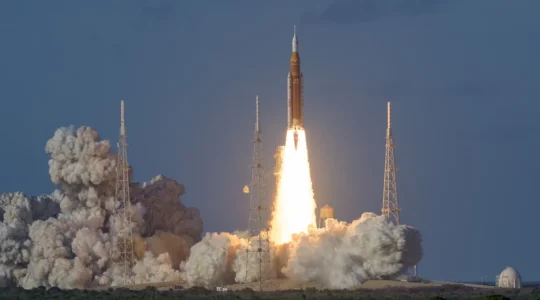
NASA’s Orion spacecraft launched on April 1 from the agency’s Kennedy Space Center in Florida.
After conducting a series of burns to break free of Earth orbit the following day, the spacecraft set its path toward the Moon.
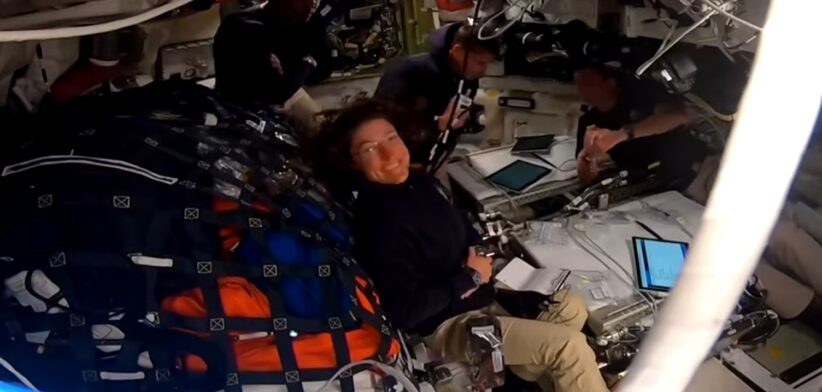
NASA astronauts Reid Wiseman, Victor Glover, and Christina Koch, and CSA (Canadian Space Agency) astronaut Jeremy Hansen are continuing to collect pictures of the Moon on their voyage away from Earth.
Jeremy Hansen said the new space travel record honoured the extraordinary efforts and feats of their predecessors in human space exploration.
“We will continue our journey even further into space before Mother Earth succeeds in pulling us back to everything that we hold dear,” he said.
“But we most importantly choose this moment to challenge this generation and the next to make sure this record is not long-lived.”
NASA acting associate administrator for Exploration Systems Development Mission Directorate Lori Glaze said the mission was “charting new frontiers for all humanity”.
“Their dedication is about more than breaking records – it’s fueling our hope for a bold future,” she said.
“Their mission is carrying our promise to return to the Moon’s surface, this time to stay as we establish a Moon Base.”
When the crew fly past the Moon they will come within about 4070 miles of its surface at the closest approach.
The astronauts will be the first to see the far side of the Moon with human eyes and are the first to travel behind the Moon. Finally, they will witness a solar eclipse as the Moon passes in front of the Sun.
“NASA is expecting to lose communication with the astronauts for about 40 minutes during a planned blackout period,” the agency said in a statement.
“The break will occur as the Moon blocks signals between the spacecraft and the Earth through the Deep Space Network.
“When Orion reemerges from behind the Moon, it is expected to quickly reacquire contact with flight controllers in the Mission Control Center at NASA’s Johnson Space Center in Houston.”
During their lunar flyby, a fleet of cameras will capture imagery of the Moon, including features humans have never directly seen.
The Artemis II astronauts are scheduled to splash down off the coast of San Diego on Friday, April 10 (US time).
For the latest mission progress, visit: https://www.nasa.gov/artemis-ii