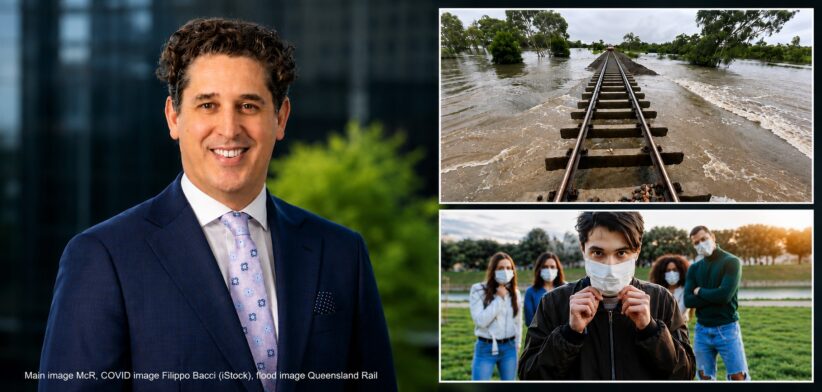
A succession of wars, natural disasters and the COVID pandemic has forced parties to rethink how they protect themselves against extraordinary events disrupting major projects.
McCullough Robertson construction partner Andrew McCormack says force majeure clauses were once “relatively remote boilerplate provisions” in contracts.
Now a succession of major events – including Queensland flooding, the pandemic and international conflicts – have put a new focus on ensuring contracts contain necessary protections.
Force majeure refers to contractual provisions that relieve parties from liability when an extraordinary, unforeseeable event beyond their control – sometimes termed ‘acts of God’ – makes delivery impossible.
Mr McCormack said an unusually concentrated period of major disruption events gave rise to risks extending beyond project sites.
“Force majeure provisions had traditionally been treated largely as protection against events that physically prevented work from proceeding – such as a flood affecting a construction site,” he said.
“But recent global shocks have broadened the focus to include indirect consequences, such as wars disrupting shipping routes or pandemics cutting contractors off from established overseas suppliers.”
There was also increasing overlap between force majeure events and price adjustment mechanisms whereas “often in the old days, we tried to keep those two apart.”
Cost escalation reshapes risk
The force majeure issue is part of a broader trend around cost escalation risk across major construction and infrastructure contracts.
McCormack said contractors had traditionally been expected to factor price escalation into their bids.
Increasingly this type of open-ended risk was too great to take without some form of price adjustment mechanism.
“Contractors now might either decline to bid or build substantial contingencies into their prices,” McCormack said.
“Contractors are saying that if you’re going to insist on that (fixed price) I’m going to need to put in a big allowance for escalation. And that could make them uncompetitive.”
Sometimes these arrangements can be restricted to particular materials or cost items, and changes can also be linked to independent measures, such as commodity indices.
Insolvency risk under increased scrutiny
Cost pressures are also sharpening scrutiny of contractor solvency.
McCormack said major project proponents were undertaking more rigorous financial due-diligence before contracts were awarded and increasingly monitored contractor finances throughout delivery.
This included more requests for parent company guarantees, and more deliberately structured security arrangements involving bank guarantees and insurance bonds.
Delay claims face tougher tests
Delays and productivity are another area of growing contractual focus.
Larger projects are imposing more demanding requirements on contractors to substantiate claims with contemporaneous records and detailed construction programs.
“Time bars – which require contractors to lodge claims within specified periods or potentially lose their entitlement – are also becoming increasingly important,” Mr McCormack said.
“If you wait six, 12 months until the end of the job, and then say ‘by the way, here’s my shopping list of things’ then there’s probably no opportunity to do anything about it and clients are keen to avoid that happening so are more motivated to enforce time bars.”
ESG moves into contract
McCormack says he is noticing environmental, social and governance obligations shifting from corporate aspirations into more robust, enforceable project requirements.
He said requirements covering areas such as modern slavery, Indigenous participation, waste reduction and sustainable practices were increasingly appearing in contracts, often being linked to KPIs, incentives and future tender assessments.
The Olympics challenges
The contractual trends are happening against a background of Australia’s construction sector being faced with capacity challenges of a swollen infrastructure pipeline.
This includes the Brisbane 2032 Olympic and Paralympic Games which will add to demand from housing, transport, social infrastructure and the energy transition.
“The Olympics is just a part of it,” Mr McCormack said. “There is also major activity happening in other areas.”
“Together, the competing programs are increasing demand on a limited pool of construction resources and delivery capacity. This is a challenge that will need to be managed”.