By Anja Bless and Milena Bojovic
Australia has long been proud of its food production. The nation produces enough to feed 75 million people – and exports 70 percent of its produce.
But this position isn’t guaranteed. Intensifying climate change is putting Australian agriculture and our food system at risk.
The Australian government last year published its National Climate Risk Assessment, showing food systems already face increased risks. Stronger and more frequent heatwaves, floods, droughts and bushfires are taking a toll on farmers, livestock, crops and fisheries.
Climate change isn’t the only risk. Fuel and fertiliser shortages in the wake of the Iran war are driving up food prices. Increased competition for water in the Murray-Darling Basin, disruptions to supply chains, the dominance of major supermarkets, and the rising cost of food are also all taking a toll as many Australians go hungry.
These challenges mean Australia can no longer take its food security for granted.
How does Australia do on food security?
A country with strong food security is one where everyone has the right to access safe, nutritious and appropriate food at all times and the food system is sustainable.
You might think Australia would do well here. But in 2025, one in five households skipped meals or went whole days without eating.
Australians also tend not to eat enough nutritious food. In 2022, 36 percent of children and adolescents and 56 percent of adults fell short of their daily fruit and vegetable intake. Of all calories consumed, 42 percent come from ultra-processed foods which can lead to higher risks of cancer, heart disease, and early death.
Australia’s supermarket sector is one of the world’s most concentrated, as Coles and Woolworths take 67 percent of sales. This so-called duopoly has long been accused of keeping prices too high.
One area where Australia performs well is food availability. But this advantage is being eroded. After decades of growth, farm productivity is now declining due to more extreme climate variability, more plant and animal diseases, pressure on water supply and other resources and other factors.
Natural disasters also restrict access by cutting off crops or livestock from markets. The end result: food gets more expensive.
Climate change is already at work
As floods become more extreme, farmers are now taking serious hits – especially in Queensland.
- In 2019, floods and sticky mud trapped and killed up to 500,000 cows.
- In 2022, record-breaking floods caused a national lettuce shortage.
- In 2023, floods hit banana, mango and avocado crops.
- In 2025, over 100,000 cows died in outback Queensland due to flooding.
This summer, it happened again. Over 48,000 cattle are dead or missing after extreme flooding in northwest Queensland.
Rising temperatures also make life harder for the animals and plants we rely on. Heat stress is on the rise in livestock. When animals are too hot, their health can suffer and milk and meat production falls.
As a recent CSIRO report shows, heat stress leads to smaller vegetable yields and worse crop quality, as well as triggering painful economic and labour market shocks.
In poultry, shifting bird migration patterns are increasing risks of diseases such as avian influenza. A recent outbreak saw egg prices spike.
The waters of the Murray-Darling Basin are becoming less reliable. These rivers support 40 percent of Australian farms, 8,400 irrigated businesses and produces $30 billion in food and fibre annually.
Climate change is intensifying competition for scarcer water resources, adding to the long-term mismanagement of the basin’s environmental health.
What can we do to boost food security?
One overlooked response is to preserve and create more local and diverse food supply chains – especially for major cities.
Sydney once supported its population with local food production. But as the suburbs have expanded, much of this has been lost – especially in the north and south-west regions.
The city of 5.5 million still produces 20 percent of its own food in the Sydney Basin. But under projected housing development scenarios, this would fall 60 percent by 2031, leaving the city only 6 percent self-sufficient. Local fresh vegetable and egg supply would fall more than 90 percent.
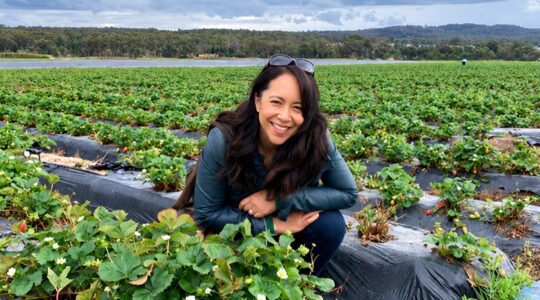
Melbourne’s food bowl faces similar development pressure. At present, farms around the city of 5.4 million meet around 41 percent of its food needs. For instance, the Yarra Valley to the northeast supplies 78 percent of Victoria’s strawberries and Casey and Cardinia shires in the city’s southeast produce 90 percent of Australia’s asparagus. These regions are all under pressure from new housing developments.
Intensified natural disasters could also block transport of food from further afield. If Sydney’s main food transport routes were cut, reserves of fresh food would only last a few days.
Looking forward
When floods devastated Lismore in 2022, the New South Wales town had empty supermarket shelves for months after main roads and freight lines were cut.
But farmers’ markets reopened within a week. As one farmer’s market manager told experts:
supermarket shelves were completely empty [but] we had all this produce.
Lismore’s experience shows how a sudden hit from a climate change linked disaster can weaken resilience in a food system already reliant on concentrated markets and limited local diversity. But it also points to how communities can respond faster than authorities.
As we face an uncertain future, we will need much better food security planning across the continent.
Boosting resilience comes in many forms, from better water and soil management to diversifying supply chains to supporting local food producers and distributors and protecting farms on the urban fringe.
Investing in more sustainable agriculture practices can cut farm emissions, reduce reliance on synthetic fertilisers and pesticides and improve resilience to climate change.
A legislated right to food could also help ensure all Australians can access healthy and sustainable food well into the future.
Anja Bless is a Lecturer in Sustainability and International Relations, University of Technology Sydney. Milena Bojovic is a Lecturer in Sustainability and Environment, University of Technology Sydney. This article was first published by The Conversation.