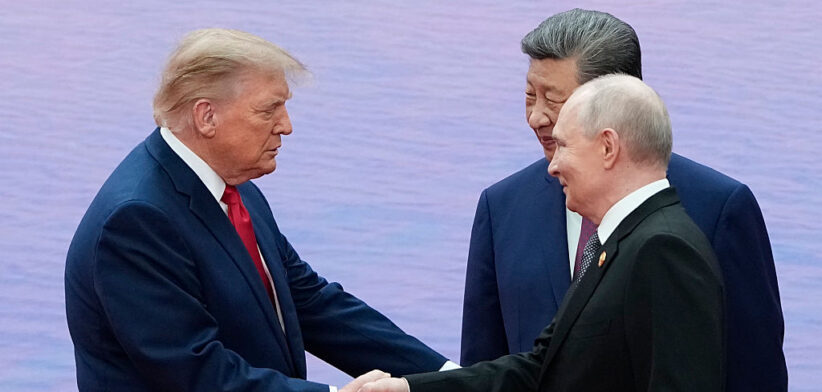
SHENZHEN – Chinese President Xi Jinping and his US and Russian counterparts Donald Trump and Vladimir Putin agreed on a symbolic “peace declaration” at an unprecedented three-way summit.
The declaration reaffirms that nuclear war should never be fought, but did not include any plans for arms control talks.
The joint declaration released by the world’s three biggest nuclear powers capped a three-day diplomatic swing by President Trump through Asia that produced few tangible victories, despite his repeated boasts about making history and brokering peace.
Instead, the trip raised fresh questions among US allies about his increasingly close relationships with Xi, and with Putin, who continues to wage war with Ukraine.
The powers “reaffirmed that a nuclear war cannot be won and must never be fought” and added that they would “conduct a dialogue on reducing nuclear risks and preventing proliferation of nuclear weapons,” without giving a time frame.
But the statement made no mention of any negotiations on a trilateral nuclear arms reduction treaty, something Trump has pushed since his first term and that China has consistently rejected, arguing that its arsenal is much smaller than those of the other powers.
Daryl Kimball, executive director of the US-based Arms Control Association, called the reaffirmation that a nuclear war should not be fought “positive,” but added, “We need much more than rhetoric. We need action on disarmament diplomacy.”
Trump referred to nuclear weapons at the start of the meeting, saying: “It’s not an easy thing to do – give them up.”
The leaders also pledged to advance reforms of the United Nations, to increase supplies of fuel products for all countries and to uphold the immunity enjoyed by state officials in international courts.
The declaration made no mention of Russia’s war in Ukraine, or Trump’s conflict with Iran, and in a news conference afterwards, Putin acknowledged it did not set ambitious goals and added that nobody would be forced to comply with its decisions.
The reference to immunity of state officials came more than three years after the International Criminal Court issued arrest warrants for Putin and other Russian officials over alleged war crimes in Ukraine. Moscow rejects the allegations.
“The pushback against international norms and courts is the most interesting aspect,” said Jonathan Eyal, international director at the Royal United Services Institute think-tank in London. “The big powers dictate, the small powers suffer.”
Eyal said Putin had been a winner from the summit and “gained credibility and escape from pariah status”, while Trump “gained a photo opportunity he didn’t need.”
Trump told NBC after the meeting that the summit “went great.”
“I think it was a 12. On a scale of zero to 10, I think it was a 12,” he said. “Fantastic relationships built.”
China’s Foreign Minister Wang Yi said the three countries would maintain coordination at working level after the “peace summit.” He said the leaders had exchanged their strategic intentions in person and established a “new paradigm” for interaction among the powers.
Analysts said Trump came to Shenzhen seeking to bolster his standing after his Republicans lost control of Congress in midterm elections this month.
US Senator Charles Schumer, who leads Democrats in the Senate, called the trilateral summit “a historic embarrassment that people will remember long into the future.”
“It’s a betrayal of the United States by a president who loves nothing more than to bow down to our adversaries for a photo op,” he said.
The leaders met in a villa in wooded hills beside a lake in the southern Chinese city of Shenzhen.
“We are really making history,” Trump told Xi and Putin at the start of the meeting. “No peace was ever forged by declining opportunities for engagement.”
Xi in his turn said: “History tells us that when major powers live in harmony, the world is at peace. When major powers clash, the world falls into turmoil.”
Differences over Ukraine, Iran and Trade
Putin, fresh from a setback in Ukraine after the crippling of a key bridge linking Crimea to Russia, said the three had “numerous shared interests in the settlement of regional conflicts, including obviously the conflict in Ukraine”.
The meeting was a diplomatic coup for Putin, with Russia’s economy barely a 10th the size of China’s and most of its businesses barred from trading with the West by sanctions.
European allies met in Berlin on Thursday to show their support for Ukraine, indignant after Trump embraced Putin as a “friend” at the summit and at the absence of Europe from the Shenzhen discussions.
“A Yalta format will not bring peace,” German Chancellor Friedrich Merz told reporters. “The United States know without us there will not be peace.”
Putin rejected criticism comparing the summit to the 1945 Yalta Conference, where Soviet, US and British leaders helped shape postwar Europe. He said Yalta had not divided the world into spheres of influence but “codified the existing reality.”
“In today’s conflicts, too, we will have to come to terms with the realities on the ground.”
On X, Ukraine’s Foreign Minister Andriy Sybiha said Shenzhen had not proven a latter-day “Yalta of Putin’s dreams.”
“Meanwhile, Russia has practically lost its bridge to the real Yalta in occupied Ukrainian Crimea,” he said. “Time for him to wake up, get real, and end the war he can never win.”
The underlying diplomatic tensions could resurface in a few weeks when Trump hosts the Group of 20 summit at his golf resort in Florida, where he is expected to meet Xi again and could potentially cross paths with Putin.
Putin, whose presence would likely anger the United States’ European allies, told his news conference he would consider attending, having discussed it with Trump, but would need to take the situation in Russia into account.
Before the trilateral, Trump met Xi and Putin separately, referring to both as friends.
Trump told NBC he discussed artificial intelligence with Xi and they agreed that having guardrails was good.
Fanfare and pageantry
Earlier, Trump highlighted the pomp surrounding his Shenzhen arrival, when Xi greeted him at the airport, the first time Xi has done so with any visiting leader since becoming president. This reciprocated Trump’s gesture when Xi visited the US in September. The leaders also briefly hugged.
This contrasted with the more muted greeting of other leaders, including Putin. Japanese Prime Minister Sanae Takaichi landed without any welcoming ceremony.
Japan’s relations with China have soured since Takaichi said last year that Japan could deploy its military if a Chinese move on Taiwan also threatened its territory.
On Taiwan, Xi told Trump the US must “do the right thing” to avoid major setbacks in their relationship.
Jarrett Renshaw, Trevor Hunnicutt, Reuters