By Kate Cantrell
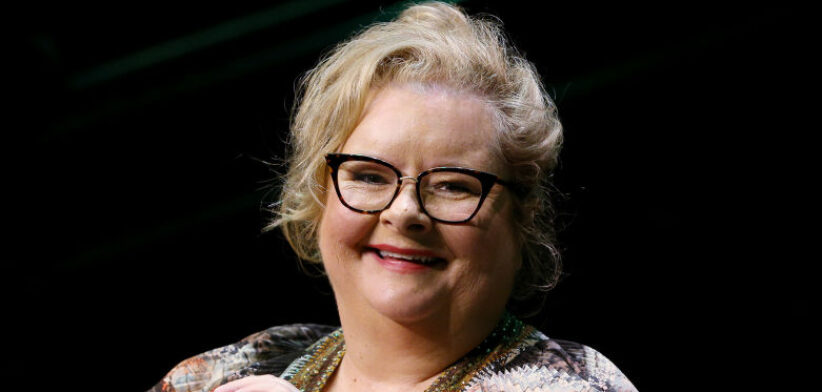
Magda Szubanski is a misfit. She knows it, she owns it and she wears it. And that’s why Australians love her.
Best known for her role as netball tragic Sharon Strzelecki on Kath & Kim, Szubanski has twice been voted the country’s most trusted celebrity.
But she’s also a formidable author. In 2016, Szubanski’s first memoir, Reckoning, won Best Biography of the Year at the Australian Book Industry Awards.
That memoir, which took eight years to write, centres on her relationship with her father, a Polish assassin who served in a top-secret counterintelligence unit during the second world war. “If you had met my father,” the book begins, “you would never, not for an instant, have thought he was an assassin.”
Szubanski’s new memoir, I Can’t Tell You But I Will, is an ode to her mother, “the love of [her] life”. It traces their tumultuous relationship against the backdrop of her mother’s death, which came just weeks before the result of the historic Australian same-sex marriage postal survey in 2017, for which Szubanski was the public face.
It was, Szubanski reflects, “a hard, hard book to write”.
In May 2025, the comedian revealed on Instagram that she had been diagnosed with mantle cell lymphoma, a rare and aggressive blood cancer with a high chance of relapse. It is “one of the nasty ones”, she said, though she has since revealed she is in “deep remission”.
In her new book, she writes:
I had begun dying, although I didn’t know it then. My cancer diagnosis […] changed everything — literally. My bone marrow, my mitochondria, my nerves and tendons. I’m still processing it.
And in the preface: “I am finishing this book in a world vastly different from the one in which I began it.”
‘A classic case of trauma’
In both her books, Szubanski prises open “the rib cage” of her family history to expose “its beating, bleeding heart”. In I Can’t Tell You But I Will, she names the source of the shame she struggled with in Reckoning.
In August 2019, almost two years after her mother’s death, Szubanski learned from her older sister Barb that her mother was gang-raped at the age of eight by a group of boys she had outplayed in a soccer game.
“Suddenly, everything makes sense,” Szubanski writes. “On fast rewind, my mind spools back through our whole life together. I understand why my mother was terrified of standing out, of being better at anything, of making people jealous.”
In the following pages, Szubanski discloses that she, too, is a victim of childhood sexual abuse:
I pushed his hands away. But his hands were like the grasping tentacles of an octopus, pulling off my clothes. And I stood there naked in that shed in front of a boy I found repulsive and a girl I had a crush on. I can’t remember how many times it happened, but I know it was many times over the course of years.
“How can something happen to you that you don’t understand?” Szubanski asks. “Why are we so fucked up about sex?” She concludes, “the silence is in direct proportion to the magnitude of the shame”.
For Szubanski, who has been in various forms of therapy since 1990, including psychotherapy and cognitive behavioural therapy, writing is the only way to untangle “the rats nest of intergenerational trauma” she believes was woven into her genes long before she was born.
When she arrived on April 12 1961 – the same day Yuri Gagarin went into space – she was born starving. “My mother suffered terribly from toxaemia during pregnancy,” Szubanski recalls.
This meant that in utero I was being poisoned and there was not sufficient nutrition passing through the placenta. So as my brain and nervous system were forming they were receiving information that there was not enough food for me […] I suspect my body has been trying to make up for it ever since.
Years later, in Byron Bay on a rainforest retreat, the adult Szubanski wakes in the night to the inexplicable sound of gunshots. As she cowers alone in her cabin, not daring to turn on the light, she realises “trauma is not just an isolated incidence of horror” or “a discrete unit of fear”. Rather, “it becomes one’s way of being in the world”.
This was when I gave my trauma a nickname: the Matrix. It was as though I glimpsed my own operating system, and I took advantage of it to observe and access my various oddnesses. At a glance, I had all the characteristics of a classic case of trauma: binge eating, occasional suicidal ideation, problems with impulse control and affect regulation.
‘Vicious’ trolling galvanised others
Szubanski describes the online abuse that followed her public appearances during the Yes campaign as “a barrage of steaming hate and nonsense”. “I never understood until now why people kill themselves over internet trolling,” she reflects: “it’s the sheer volume.”
Such attacks, especially on women, are hardly new, but the trolling of Szubanski was particularly vicious. She calls it “a demolition job [with] high-density explosives placed at strategic spots” and writes: “I have never felt so hated.”
Ironically, research on performative trolling suggests the vitriolic abuse backfired. Rather than silencing Szubanski, it galvanised others and incited further expressions of support.
The highs and lows
The uneasy pairing of pain and joy – in herself and those she loves – is the central theme of Szubanski’s life, and her writing.
Her father, “a feminist male chauvinist”, raised her to believe she can be “as good as any man […] at anything”. But when she finally came out to her parents, he insisted the “gay gene” wasn’t from his side.
Szubanski’s mother, “a grand and complex woman” with “a demon inside her”, subsisted on lollies and Cadbury Favourites. She wielded “the only weapon she had: her thinness” to taunt her daughter: “The only time you ever get up is to go to the fridge! You had such a belting figure and to see you distorting yourself like that!”
“In the psychological war between my parents,” Szubanski writes, “I was collateral damage.”
Once marriage equality is enshrined in law, Szubanski, characteristically modest, is unequivocal about who the moment belongs to:
It belongs to the people who marched, wrote, phoned, doorknocked, argued with relatives, endured the survey, opened their lives for public inspection, and then got up the next morning and kept going. It belongs to the people who did not live to see it.
Humour is the life line
Szubanski’s memoir isn’t a belly laugh, but when she turns her eye to the twin sources of her anxiety – her weight and her sexuality – her prose is as funny as her comedy, and far more candid.
Of gay people, she writes: “You can’t breed us out of existence because we do originate mostly from straight people.”
Of her childhood, she says: “All I was good at was watching TV and eating Brockhoff biscuits.”
On her past desire to have children, she writes: “Only fertile heterosexuals can get pregnant accidentally. The rest of us need to plan like doomsday preppers.”
In Reckoning, Szubanski describes her relationships with her Kath & Kim co-stars Jane Turner and Gina Riley as “two of the most important relationships of [her] professional life”.
She concedes that were it not for her “bruised heart”, she might never have created her most iconic character, Sharon Strzelecki: the “sport-obsessed optimist” and “perpetually put-upon, unlucky-in-love second-best friend”.
“People frequently ask me where Sharon comes from,” Szubanski writes. “In truth, Sharon is the most vulnerable part of me. I suspect that vulnerability has always been present in my work but it found its most perfect expression in Sharon.”
For most of her life, comedy has been a camouflage for Szubanski – a way of staying hidden in plain sight. At convent school, her status as class clown, secured by her impressions of the nuns, was a form of “diplomatic immunity”.
“I was a good mimic,” Szubanski recalls. “At long last I was safe.”
‘Cancer has changed me’
In a recent conversation with the ABC’s Richard Fidler, Szubanski said that although she feels “strong in spirit”, she is “physically knackered”.
“Cancer completely changes everything,” she said. “One is the uncertainty, the fear of relapse […] and then there’s the other thing of not much time for bullshit, because cancer is a full-time job.”
Szubanski is no stranger to cancer: it shadowed her family long before her diagnosis in 2025.
Her father was 41 when he was diagnosed with a soft-tissue sarcoma: “a tumour the size of a man’s fist” in the back of his left thigh. He survived and lived for decades more. A year after his death, Magda’s mother was diagnosed with pancreatic cancer, a disease that “often dispatches its victims within a matter of months”.
“Grave illness is the only language my family understands,” Szubanski writes. “What our mouths dare not say our bodies will speak. Somatisation is the technical term.”
It was not until her mother took seven long days to die – and she watched as “the stubborn engine of [her] body jolts and sputters” – that Szubanski realised what humour truly is: a form of grace.
Szubanski’s writing meditates on what we owe ourselves and the dead. She exposes the fantasy that our lives are stable, predictable and containable. Illness and death shatter this illusion, revealing that we depend on one another to survive and that, in the end, the beauty and brutality of living – “the real stuff of life” – makes misfits of us all.
Kate Cantrell is a Senior Lecturer in Humanities, University of Southern Queensland. The full version of this article was published by The Conversation.
The National Sexual Assault, Family and Domestic Violence Counselling Line – 1800 RESPECT (1800 737 732) – is available 24 hours a day, seven days a week for any Australian who has experienced, or is at risk of, family and domestic violence and/or sexual assault.