Humans appear to have started using mind-altering substances tens of thousands of years ago, according to new research.
Griffith University archaeologists say that the latest findings put drug use much earlier than previously thought.
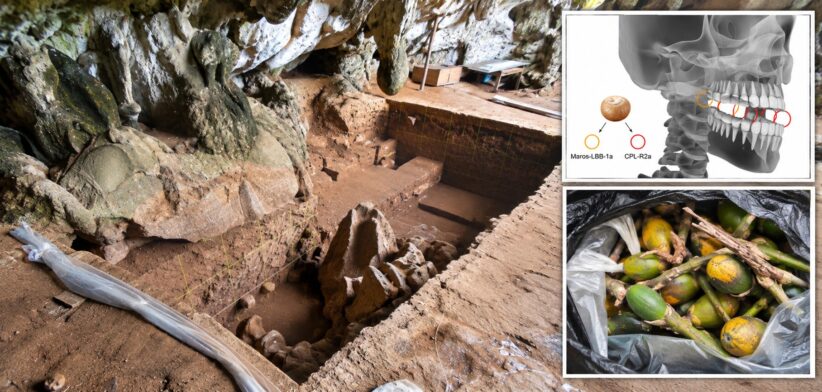
Their work revealed evidence that the betel nut was used as a drug in some Indonesian communities up to 25,000 years ago.
Previous evidence suggested drug use only dated from the Neolithic or Bronze Age, around 3500 years ago.
The new research, released this week, was led by Professor Adam Brumm from Griffith’s Australian Research Centre for Human Evolution (ARCHE).
Professor Brumm, supported by Associate Professors Carney Matheson and Michelle Langley, combined biochemical and archaeological evidence to trace the prehistoric roots of betel nut use.
They collaborated with Indonesian archaeologists from Makassar’s University of Hasanuddin and the National Research and Innovation Agency (BRIN).
Professor Brumm said previous thinking was that the world’s first traditions of “psychoactive” drug use arose after the Neolithic advent of farming.
It began with the innovation of fermented alcoholic drinks (barley beer) about 13,000 years ago in Israel.
“However, this theory fails to account for the possibility that very ancient drug-taking lies at the roots of our most commonly used psychoactive substances,” Professor Brumm said.
Professor Brumm’s investigation focused on the origins of betel nut usage.
The nut is described as a “near-universal tradition among hundreds of millions of people between India and the South Pacific (about one in 10 of the modern global population)”.
“Consuming betel nut induces a sense of mild euphoria and heightened alertness, among other effects,” the researchers said.
“Although poorly known in western societies, it is the world’s fourth most widely used psychoactive substance, after alcohol, caffeine and nicotine.”
The early history of betel nut use had remained uncertain, largely because areca seeds were rarely preserved at archaeological sites.
The new study, published in Science Advances, related to two “extremely rare” skeletal remains of two early human foragers from the Indonesian island of Sulawesi.
Both hunter-gatherers display a highly unusual dental-wear pattern (deep, rounded tooth grooves), a novel bioarchaeological marker the researchers established was caused by a habitual sucking of whole betel nuts.
Biochemical analyses by Associate Professor Matheson also detected the presence of arecoline in the dental tissues of the foragers, providing strong evidence for betel nut ingestion.
“Taken together, the findings suggest early foragers in Sulawesi engaged in an ancient and longstanding practice of habitually sucking betel nuts, resulting in dramatic alterations to their teeth,” the researchers said.
Professor Brumm said the study suggested betel nut-sucking may be the earliest evidence for drug use anywhere in the world.
“By identifying the ancient practice underlying betel-nut chewing as we know it, the study implies that some modern drug-taking behaviours are deeply rooted in forager traditions,” he said.
The full study report is here.