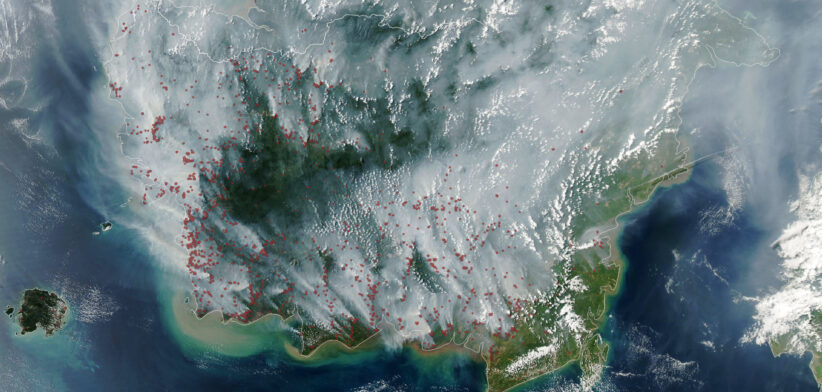
Indonesia is experiencing a sharp rise in high intensity, underground peatland infernos off the back of an El Niño-induced dry season.
The fires have caused hazardous smoke haze, school closures and flight delays.
According to NASA’s Earth Observatory, peat fires are estimated to generate three times more fine particulate matter than other tropical forest fires.
They also produce five times more sulfur dioxide, three times more organic carbon, and two times more methane and carbon monoxide.
“If there were an apex predator among fires, tropical peatland fires would be a top contender,” NASA said in a statement.
“These fires, which burn in dried wetland soils, are slow burning, highly polluting, and notoriously difficult to extinguish because they smolder at low temperatures and often burn underground through expansive deposits of peat.”
Columbia University researcher Robert Field said, unlike surface fires, when fires took off underground, they did not stop.
They were likely to keep burning until the rainy season in October or November.
“Indonesia is only about three weeks into its fire season, but we’re seeing fire activity track sharply upward, similar to 2015,” Dr Field said.
“The strong El Niño is making the dry season drier over the fire-prone parts of the country and exacerbating burning—just as we anticipated it would.”
In 2015, after burning for more than three months, Indonesia’s fires had released 1.75 billion tons of greenhouse gas equivalents—more than Japan emits in a year.
As of September 2, 2026, Indonesia’s 2026 fires, after a month of burning, had released around 10 percent as much as the 2015 fires, NASA said.
About 90 percent of Indonesia received little to no rainfall in early August, creating the conditions for the fires.
“Peat fires are a recurring challenge in Indonesia, which is home to about 36 percent of the world’s tropical peatlands,” NASA said in the statement.
“When parched by drought, the archipelago’s peat landscapes have become unrelenting infernos on several occasions over the past three decades, with fires producing blankets of smoke for weeks on end and upending daily life for millions of people.”
NASA said the smoke was already causing widespread disruptions.
Indonesian officials had warned that large swaths of the population had been exposed to hazardous smoke.
Some schools had started shifting to remote learning, nine national parks had closed, and several flights have been delayed due to heavy smoke.
The full report is here