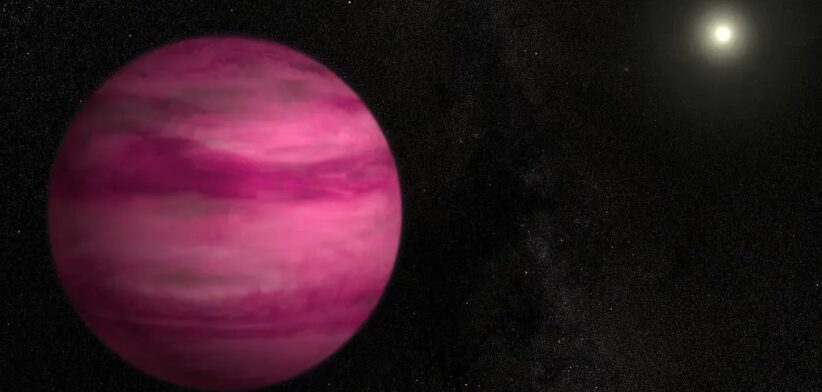
New research has unlocked the secret of the giant “pink planet” that baffled astronomers for more than a decade.
Northwestern University-led scientists have discovered the planet, known officially as GJ504b, is surrounded by salty skies.
The elusive planet is too faint for astronomers to dissect its light from Earth.
However, new observations from the James Webb Space Telescope (JWST) have revealed the planet’s atmosphere has an “exotic chemistry” consisting of salty clouds never before encountered.
“The observations provide some of the first direct evidence for salt clouds in a cold object’s atmosphere, a phenomenon scientists theorized more than 15 years ago,” Northwestern University said in a statement.
“The discovery also marks an important step toward studying increasingly cold objects, which are too dim to examine with ground-based telescopes.”
The study was published this week in the Astronomical Journal.
Study lead Aneesh Baburaj said the pink planet was the “coldest companion” ever discovered using ground-based instruments.
“Many teams all around the world performed follow-up observations to study its light, but it was too faint for ground-based instruments. That made it a perfect target for JWST,” he said.
“When we finally obtained its spectrum, it immediately looked interesting. But once we started digging deeper into the data, we realized it was not like anything we have analysed before.”
The Pink Planet was discovered in 2013. It orbits a sun-like star located 57 light-years from Earth.
Despite its nickname, astronomers are not fully sure if it is a real planet.
“At roughly 25 times the mass of Jupiter, GJ504b sits near the fuzzy boundary between giant planets and brown dwarfs,” the study report said.
“So, astronomers refer to it as a ‘planetary-mass companion’, meaning that it’s a planet-sized object orbiting a star.”
The planet’s age is responsible for its cold temperature. It is believed to be between 2.5 billion and 4 billion years old.
The data from the object revealed a mix of chemicals, including water vapor, methane, carbon dioxide, ammonia and other molecules, and salt.
“This is the first time we’ve found that salt clouds are critical to explaining the spectrum of an object,” Mr Baburaj said. “It’s a good reminder to account for clouds in our models.”
The full report can be found here