Australian businesses are being urged to lean into Artificial Intelligence – but not without strict guardrails and a clear understanding of when human intervention is needed.
Chief Information Officer of PwC Australia’s Advisory Practice, Charmaine Chalmers, says Generative AI has become a “rock star” in the corporate world.
“At the moment, everyone’s talking about it – business leaders are excited, but also wary, about what that means for the future – for their people, businesses and industries,” she said.
“We are encouraging people to experiment, but with strong guardrails – with humans in the loop, reviewing outputs and exercising judgement.”
Ms Chalmers has been a PwC partner for 15 years. She leads a team of technicians — including software engineers, AI specialists, data scientists and business analysts.
Her work sits at the intersection of technology strategy and human impact.
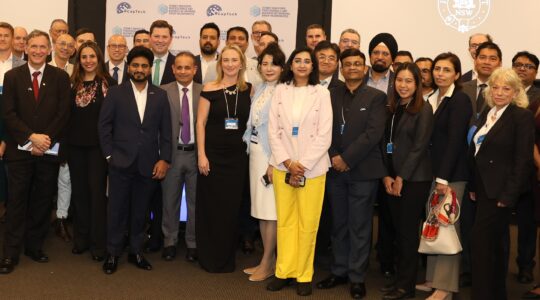
She recently shared her views on Gen AI at the Women in Technology breakfast in Brisbane.
Establish the guardrails early
Ms Chalmers said it was important that firms built trust into their AI strategy early.
This should be done by establishing guardrails and decision rights, and embedding controls (including endorsed tools) to reduce the risks of employees using unapproved models.
The guardrail-first philosophy was not about slowing things down. It was about creating the conditions under which organisations can move faster, and with more confidence.
“For example, if you are drafting a report that will be reviewed by humans, then the risk of the final output of containing material errors is lowered,” she said. “So knock yourselves out (with experimentation).”
The contrast from this approach was allowing AI to make automated decisions and “writing back” to corporate systems with no human checking.
“That is a very different use case and has very different consequences,” she said.
“Having a risk-tiered approach as to how you foster that bottom-up engagement (is important).”
Ms Chalmers said if people had great tools and the chance to be creative, “magic” would happen through the combination of staff with deep business and process knowledge and powerful “out of the box” Gen AI tools.
Leadership on AI is crucial
Fears about the impact of AI on jobs were not limited to junior staff.
Ms Chalmers said many senior executives in the audience at one of her recent panel sessions said they were worried that AI might take their jobs.
More than one billion job ads across six continents were analysed in PwC’s 2026 Global AI Jobs Barometer, which found AI is reshaping jobs in fundamentally different ways, rather than replacing them at scale.
The research identifies two distinct job tracks emerging in the labour market.
“Professionalised” roles are those where AI handles routine tasks and elevates the importance of human expertise, judgement and creativity.
“Democratised” roles are those where AI takes on more complex tasks, leaving people with less demanding work.
These two tracks are producing markedly different outcomes for workers in terms of job growth, skills demand, and pay.
“There is a lot to manage between the excitement for future opportunities and the psychological safety of our people during this period of immense change,” Ms Chalmers said.
“We need strong leadership now more than ever.
“There’s a big role for us as leaders, to lean in on this – this is not something we can delegate to the tech team. This is not something you push to a junior.”
Skills needs and recruitment
The explosion of Gen AI was also raising issues around corporate skill needs and recruitment.
The people needs of companies were changing and there was no such thing as an “AI engineer” with decades of relevant experience in agentic workflows.
Ms Chalmers said the field was nascent, which meant traditional hiring criteria no longer applied cleanly.
PwC’s AI Jobs Barometer data helps explain why.
Across roles most exposed to AI, new tasks were 2.5 times more likely to require human-intensive capabilities, among them empathy, judgement, creativity, and the ability to lead through ambiguity.
These were not soft additions to a technical job description.
They were becoming the primary differentiator between candidates who could operate effectively with AI and those who could not.
“Now we are looking for people with domain expertise, strong problem-solving skills and genuine curiosity around Gen AI, as well as a history of self-learning,” Ms Chalmers said.
“It’s causing us to think differently about what AI experience means for talent, because the roles that will be most valuable are increasingly those that combine technical confidence with judgment, collaboration and the ability to lead.”
This had real implications for how organisations invested in their people, she said.
Upskilling could no longer be an afterthought or a once-a-year training day.
It needed to be woven into how work gets done.
“Enabling our people means they can spend less time doing repeatable, manual, soul destroying work, and concentrate on work that engages them, stretches them and adds value,” Ms Chalmers said.
“The impact of my work on our clients means that the speed and accuracy of the work that they receive from us is greater.
“This means they get richer subject matter expertise and human judgement from their PwC relationship team.
“It’s all about the impact on people – about elevating people to be able to spend the time on the things that matter.”
Upskill and be ready
For individual professionals, Ms Chalmers’ advice was equally clear.
The workforce of the future would be generative AI-enabled, and the best time to build that fluency was now, before it became a prerequisite rather than a differentiator.
“The best possible position you can be in is to be very familiar and confident with these tools as an enabler to your role,” she said.
Helping clients make the transition
Ms Chalmers said she helped clients realise the potential of Gen AI by turning a complex landscape into something “tangible, prioritised and executable”.
“I work closely with clients to accelerate their AI journeys – from building executive understanding and alignment, through to establishing the trust and governance frameworks that allow organisations to move with confidence,” she said.
“This includes the hands-on upskilling that embeds capability with those with domain expertise and deep knowledge of business processes.”
She said the goals were always the same:
- Help organisations reimagine how they go to market
- Deepen how they engage with their customers
- Meaningfully reinvent processes
- Liberate time for people to focus on the work that truly requires their judgment.
For organisations ready to move from activity to genuine transformation, that work starts with a conversation.
Ms Chalmers can be contacted here.