Migration of people from capital cities to the regions has hit a record high as tree changers and sea changers seek out alternative housing, work and lifestyle options.
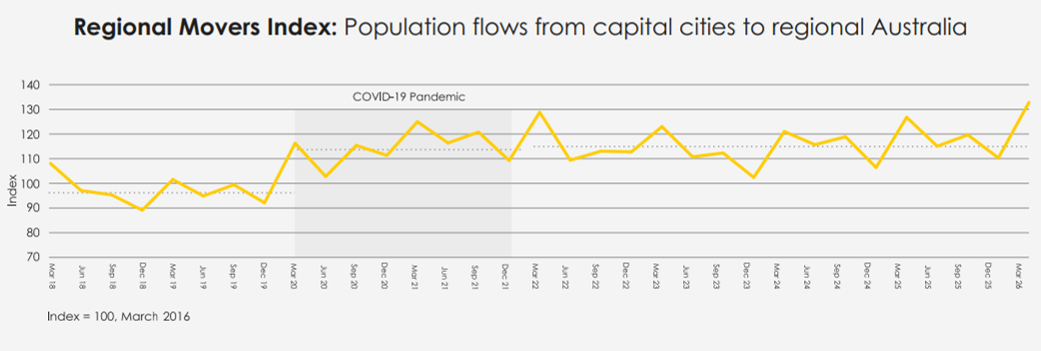
The latest Regional Movers Index (RMI), released today, showed that capital city residents moving to the regions outnumbered those moving in the opposite direction by 29.7 percent.
The March quarter RMI had Queensland’s Sunshine Coast continuing to dominate regional migration with an 8.8 percent share of the net gain from capital cities.
Others in the top five were Greater Geelong (Vic), Fraser Coast (Qld), Moorabool (Vic) and Lake Macquarie (NSW).
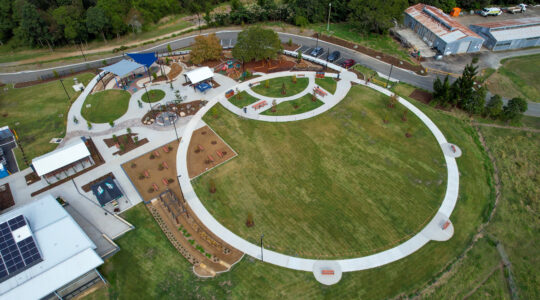
Toowoomba, on Queensland’s Darling Downs, was a big favourite for metro movers in the March quarter, with a 236 percent increase from the same time last year.
This was the strongest year on year growth in net inflows from capitals of any local government area in Australia.
The “Garden City” was also a popular destination for people moving within the regions.
The net regional drift in March was the largest since the index began. The Index was up 20.1 percent on the December 2025 quarter and 4.7 percent higher than a year earlier.
Sydneysiders accounted for 55 percent of net capital outflows, followed by Melburnians at 36 percent.
Although Sydney and Melbourne continued to dominate regional moves in the March quarter, Brisbane, Perth and Adelaide all recorded an increased share of net outflows.
This suggested movement from capital cities was becoming increasingly “broad-based”.
The RMI is a partnership between the Commonwealth Bank of Australia (CBA) and the Regional Australia Institute (RAI).
RAI CEO Liz Ritchie said the record result confirmed the enduring and growing appeal of regional living.
“This is the highest level of capital to regional movement the RMI has ever recorded,” she said.
“Australians are continuing to choose regional life in greater numbers, even as economic conditions shift.
“Across COVID, inflation, housing pressures and tight labour markets, the trend has been remarkably consistent – people are leaving capital cities for regions, and they’re doing so at increasing rates.”
Ms Ritchie said the data was extremely valuable for population and infrastructure planning.
“We’re not just tracking movement but providing early indications of where regional growth is emerging, so government, investors, industry and communities can respond before pressure builds,” she said.
“It helps identify the places that are emerging as hotspots that may need new thinking around housing and infrastructure.”
CBA Regional and Agribusiness Banking Executive General Manager Kylie Allen said the record RMI result reinforced the long-term strength of regional Australia.
“What stands out this quarter is the scale of movement we’re seeing, both from capital cities and between regional communities,” she said.
“It reinforces the role that regional centres like Toowoomba play as important hubs, supporting surrounding towns through jobs, services and local business activity.”