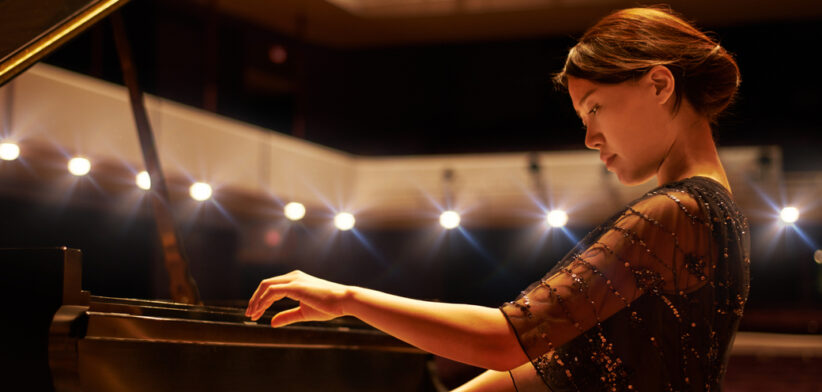
A long-standing debate in music circles on the impact of touch on a piano’s sound appears to have been settled.
According to the Japan-based NeuroPiano Institute, pianists and music teachers have been arguing for more than 100 years over the ability of a performer’s touch to change the “tone colour” of a piano note.
New research says it can, and this may change the way piano is taught in the future.
By tracking piano key movements at 1000 frames per second, the researchers discovered that elite pianists subtly manipulate keys in ways that listeners can genuinely hear.
“For generations, pianists and music teachers have insisted that a performer’s touch can change the character of a piano’s sound,” a research report publsihed in Science Daily said.
“Skeptics argued that once a piano hammer strikes a string, the resulting tone is determined almost entirely by the instrument itself.”
The new research, published in the Proceedings of the National Academy of Sciences (PNAS), suggests that the subtle motions of a pianist’s fingers and hands influence how listeners perceive qualities such as brightness, heaviness, and clarity in musical notes.
“While musicians often describe tones as warm, dark, bright, or heavy, many scientists believed these differences were mostly psychological or caused by changes in volume and timing rather than touch itself,” the research report said.
“The new research challenges that assumption.”
As part of the research, 20 internationally acclaimed pianists were asked to play notes while intentionally producing contrasting tonal qualities.
The results showed that listeners consistently recognised the intended timbres.
“This was true even for people with no musical training,” the report said. “Professional pianists in the listening tests were especially sensitive to the differences.”
In fact, the research showed that altering a single movement feature could reliably change how listeners described the sound.
The study said subtle gestures were part of a shared motor skill developed through years of advanced piano training.
The research team believes these discoveries could transform music education by making expressive techniques easier to teach and visualise.
“Instead of relying only on vague instructions such as ‘play warmer’ or ‘use a lighter touch’, future training systems may be able to show students the exact physical movements associated with specific tonal qualities,” the report said.
“The findings may also influence rehabilitation science, neuroscience, robotics, and human computer interaction.
“The study highlights how advanced motor control can shape perception itself, offering clues about how the brain integrates movement and sensory experience.”
The Science Daily report and links to the research are available here.