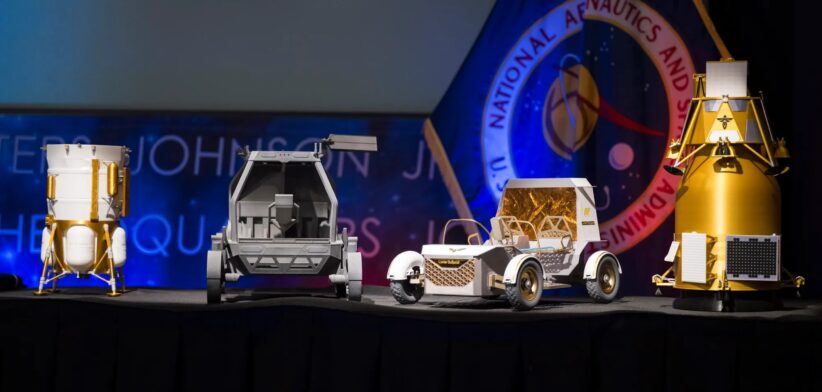
NASA has unveiled its shopping list of equipment needed for the early stages of building its Moon Base.
Overnight the agency announced new contracts for lunar rovers for crew to drive and uncrewed cargo landers bound for the Moon.
NASA Administrator Jared Isaacman said the Moon Base would be America’s and humanity’s “first outpost on another celestial world”.
“Every mission, crewed and uncrewed, will be a learning opportunity as we return to the lunar surface, build the infrastructure to stay, and master the skills required to live and operate in one of the most demanding and dangerous environments imaginable,” he said in a statement.
“We will go for the science, for all we stand to gain from an economic and technological perspective, for the innovations that will make life better here on Earth, and to prepare for where we will inevitably go next.”
NASA has announced the first three Moon Base missions to begin building a sustained presence.
Moon Base I
Targeted for launch later this year, this mission will use Blue Origin’s Blue Moon Mark 1 Endurance lander to deliver NASA payloads. Equipment will include the Stereo Cameras for Lunar Plume-Surface Studies instrument to study how thrusters interact with the Moon’s surface, and the Laser Retroreflective Array, which helps orbiting spacecraft determine a more precise location using reflected laser light.
Moon Base II
Also planned for launch later this year, this mission will deliver more than 498kg of cargo on Astrobotic’s Griffin lander, including Astrolab’s FLIP rover.
Moon Base III
This mission will fly the first payload selected through NASA’s Payloads and Research Investigations on the Surface of the Moon initiative. Its anchor investigation, Lunar Vertex, will fly on Intuitive Machine’s Nova-C Trinity lunar lander and study lunar swirls, or light spots on the surface of the Moon, to improve understanding of surface evolution and material behavior under extreme conditions.
These missions are the first of more than a dozen missions that will be detailed this year.
NASA has announced a series of contracts to build and deliver the equipment.
It said early surface mobility was a foundational component of the national space policy priority to create an enduring lunar presence.
The agency also released updates on MoonFall, a mission that will send four drones to fly short hops on the lunar surface to survey potential landing sites for Artemis astronauts.
The drones will independently land on the lunar surface and then gather high-resolution imagery of hard-to-reach terrain over the course of a single lunar day.
“As part of the Golden Age of innovation and exploration, NASA will send astronauts on increasingly difficult missions to explore more of the Moon for scientific discovery, economic benefits, and to build on our foundation for the first crewed missions to Mars,” NASA said.