The prestigious Michelin food guide has released its seven biggest food trends of 2026.
This year the revered restaurant inspectors say there is a general shift towards a more personalised style of eating, with emphasis on sourcing ingredients that reflect traditional, unhurried ways of doing things.
1. Where there’s smoke
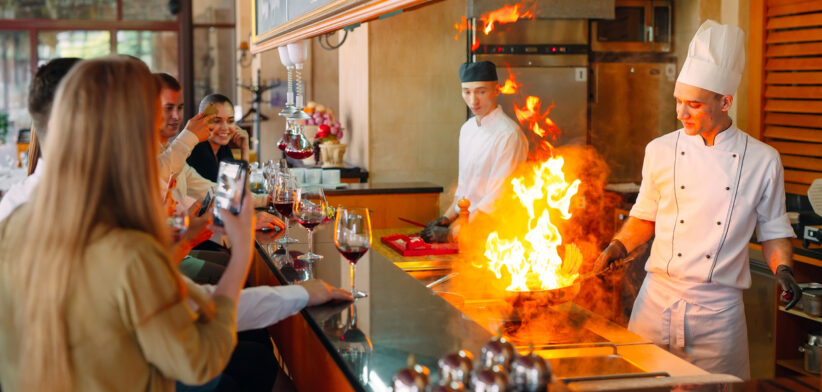
It’s back to caveman basics with fire used to bring out simple flavours and create some atmosphere.
Chefs are cooking over embers, wood, hot stones, or binchotan (white Japanese coal). Michelin mentions restaurants like Sweden’s Knystaforsen, Buenos Aires’ Anchoita and Don Julio where fire-grilling is refined and contemporary.
“In China, chefs are using fire to bring clarity of flavour by cooking simple fish and shellfish over charcoal – for example, grilled prawns brushed with fermented soy, or clams cooked briefly over charcoal and finished with a touch of vinegar for balance,” according to Michelin.
2. Traditional meets contemporary
In countries where things have always been done a certain way, there is a new awakening where tradition is evolving quickly.
Michelin cites Hungary and Poland, where chefs conjure homestyle dishes that are still recognisable, but served in a more polished and lighter way. Think BABA with its meatloaf, or IDA kuchina I wino with herring and potato served with lighter touches of apple, cider and buttermilk.
Asia is taking it further with the reinterpretation of “traditional dishes to express cultural identity or tell stories,” in Ho Chin Min at CieL, in Kuala Lumpur at Akar, and in Chengdu at Co-.
In China traditionally foraged or “wild mountain ingredients” such as mushrooms of the porcini, matsutake and termite variety are served in dishes influenced by cuisine from Yunnan, Guizhou or Sichuan provinces.
3. Bitterness and depth with umami
Many chefs are embracing umami – or the fifth basic taste which is best described as meaty, savory and rich, and adds depth and complexity to food.
Although it has a Japanese name, it is also found in cheese, tomato sauce, stocks, and pickled or fermented dishes.
At Plates London, Michelin says the warm coca sponge comes with parsnip ice cream and a touch of miso, and at Baan Tepa in Bangkok, in-house ferments are prepared weeks in advance.
In China tea is increasingly being used to cook to add flavour from the tannins and aroma in the leaf.
4. Time is used as an ingredient concept
Some dishes cannot be hurried and take more time to prepare than others.
This concept of slow cooking or preparation is important in the fermentation process to develop depth of flavour and richness.
Michelin says on France’s Atlantic Coast, La Marine in L’Herbaduiere matures fish on-site in cold rooms and serves up daily portions so the “flavour becomes more nuanced while also helping reduce waste. And at l’Auberge Saint-Mathieu chefs at this Quebec restaurant “adapt to the long winters by conserving ingredients using lacto-fermentation.”
5. French bistro cooking
Perhaps it’s the popularity of Netflix’s Emily in Paris, but there is an increasing demand for down-to-earth, traditional French bistro-style cooking a-la Gabriel’s restaurant L’Esprit de Gigi.
Michelin mentions simple classics such as blanquette (white meat in white sauce), oeufs mayonnaise (boiled eggs in a mayonnaise and mustard sauce), and ile flottante (soft meringue on custard).
These are served in an atmosphere of classic Parisian-style dining with red velvet banquettes, vintage photographs, and shelves with collectibles.
6. In-person service
No more ordering from a basic QR code, people want real service. Sometimes this is in the form of trolley service, where the waiter will bring dishes to choose from at the table; or counter service, where dishes are finished in view of guests.
Sitting at a counter, near the kitchen creates a more immediate connection to the preparation, and the team behind it.
“In Quebec, counters are almost everywhere, offering a friendly and casual moment where service often feels young and disarmingly informal,” Michelin says.
7. New food hubs
Traditionally, when chefs want to learn something new, they head to France or Japan. But attention is now also focusing on Bangkok and China where serious new restaurant openings are growing the food scene with respected chefs and growing investment.
Some examples given by Michelin are Duet by David Toutain in Bangkok, Thailand; and Chef Kang in Fujian, China.
More details are on the Michelin website.