Ancient cave art discovered in Indonesia is providing clues to the origins of early Australian indigenous populations.
A research team, co-led by Southern Cross University, Indonesia’s national research and innovation agency (BRIN) and Griffith University, found and dated the paintings on the island of Sulawesi.
They are believed to be at least 67,800 years ago.
Dr Adhi Agus Oktaviana, a rock art specialist and team lead, said the paintings had far-reaching implications for understanding the “deep-time history” of Australian Aboriginal culture.
“It is very likely that the people who made these paintings in Sulawesi were part of the broader population that would later spread through the region and ultimately reach Australia,” Dr Oktaviana said.
The artwork was preserved in limestone caves in southeastern Sulawesi on the satellite island of Muna.
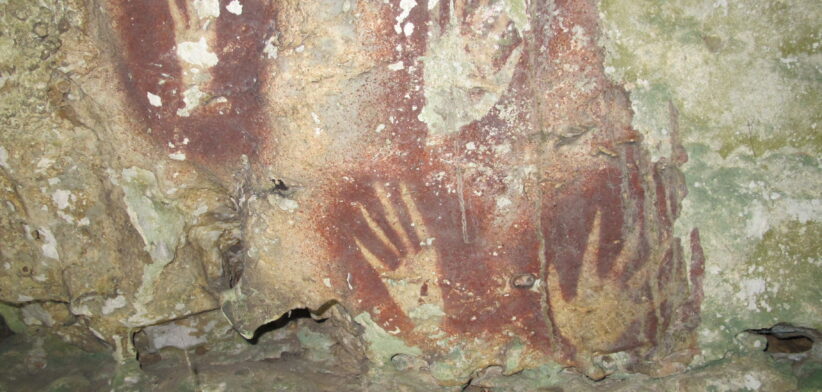
A “fragmentary” hand stencil was found surrounded by painted art of a much more recent origin.
The hand stencil was dated to a minimum of 67,800 years ago, making it the oldest reliably dated cave art yet discovered, significantly older than the rock painting found in Sulawesi by the same researchers in 2024.
Professor Renaud Joannes-Boyau from the Geoarchaeology and Archaeometry Research Group (GARG) at Southern Cross University, who co-led the research, said the discovery cast light on the most likely course of humans’ “ancient island-hopping journey” from mainland Asia to Sahul via the northern route.
“With the dating of this extremely ancient rock art in Sulawesi, we now have the oldest direct evidence for the presence of modern humans along this northern migration corridor into Sahul,” Professor Joannes-Boyau said.
The new finding also revealed the Muna cave was used for making art over a very long period, with paintings produced repeatedly for at least 35,000 years, continuing until about 20,000 years ago.
“It is now evident from our new phase of research that Sulawesi was home to one of the world’s richest and most longstanding artistic cultures, one with origins in the earliest history of human occupation of the island at least 67,800 years ago,” Professor Maxime Aubert, from the Griffith Centre for Social and Cultural Research (GCSCR), said.
More details are available here.